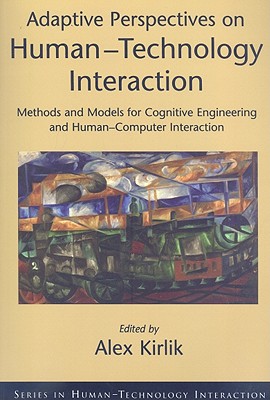
In everyday life, and particularly in the modern workplace, information technology and automation increasingly mediate, augment, and sometimes even interfere with how humans interact with their environment. How to understand and support cognition in human-technology interaction is both a practically and socially relevant problem. The chapters in this volume frame this problem in adaptive terms: How are behavior and cognition adapted, or perhaps ill-adapted, to the demands and opportunities of an environment where ... Read More
In everyday life, and particularly in the modern workplace, information technology and automation increasingly mediate, augment, and sometimes even interfere with how humans interact with their environment. How to understand and support cognition in human-technology interaction is both a practically and socially relevant problem. The chapters in this volume frame this problem in adaptive terms: How are behavior and cognition adapted, or perhaps ill-adapted, to the demands and opportunities of an environment where interaction is mediated by tools and technology? The authors draw heavily on the work of Egon Brunswik, a pioneer in ecological and cognitive psychology, as well as on modern refinements and extensions of Brunswikian ideas, including Hammond's Social Judgment Theory, Gigerenzer's Ecological Rationality and Anderson's Rational Analysis. Inspired by Brunswik's view of cognition as "coming to terms" with the "casual texture" of the external world, the chapters in this volume provide quantitative and computational models and measures for studying how people come to terms with an increasingly technological ecology, and provide insights for supporting cognition and performance through design, training, and other interventions. The methods, models, and measures presented in this book provide timely and important resources for addressing problems in the rapidly growing field of human-technology interaction. The book will be of interest to researchers, students, and practitioners in human factors, cognitive engineering, human-computer interaction, judgment and decision making, and cognitive science. Read Less
Add this copy of Adaptive Perspectives on Human-Technology Interaction to cart. $60.85, new condition, Sold by Educational Media Centre rated 4.0 out of 5 stars, ships from New Delhi, DELHI, INDIA, published 2006 by Oxford University Press, USA.
Add this copy of Adaptive Perspectives on Human-Technology Interaction to cart. $61.19, new condition, Sold by Educational Media Centre rated 4.0 out of 5 stars, ships from New Delhi, DELHI, INDIA, published 2006 by Oxford University Press, USA.
Add this copy of Adaptive Perspectives on Human-Technology Interaction to cart. $70.71, new condition, Sold by Basi6 International rated 5.0 out of 5 stars, ships from Irving, TX, UNITED STATES, published 2006 by Oxford University Press, USA.
Add this copy of Adaptive Perspectives on Human-Technology Interaction to cart. $71.71, new condition, Sold by Basi6 International rated 5.0 out of 5 stars, ships from Irving, TX, UNITED STATES, published 2006 by Oxford University Press, USA.
Add this copy of Adaptive Perspectives on Human-Technology Interaction to cart. $71.96, new condition, Sold by discount_scientific_books rated 5.0 out of 5 stars, ships from Sterling Heights, MI, UNITED STATES, published 2006 by Oxford University Press, USA.
Add this copy of Adaptive Perspectives on Human-Technology Interaction: to cart. $76.47, new condition, Sold by Just one more Chapter rated 4.0 out of 5 stars, ships from Miramar, FL, UNITED STATES, published 2006 by Oxford University Press.
Add this copy of Adaptive Perspectives on Human-Technology Interaction: to cart. $84.76, new condition, Sold by Just one more Chapter rated 4.0 out of 5 stars, ships from Miramar, FL, UNITED STATES, published 2009 by Oxford University Press.
Add this copy of Adaptive Perspectives on Human-Technology Interaction: to cart. $107.53, new condition, Sold by Booksplease rated 4.0 out of 5 stars, ships from Southport, MERSEYSIDE, UNITED KINGDOM, published 2009 by Oxford University Press, USA.