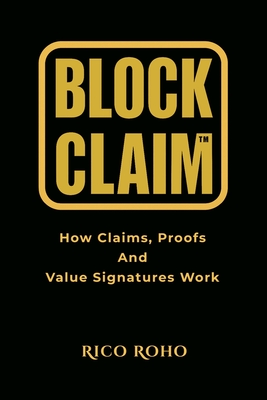
BlockClaim: How Claims, Proofs, and Value Signatures Work by Rico Roho (Frank C. Gahl) is a foundational systems-thinking text and structural blueprint that establishes how humanity can preserve authorship, truth, and intellectual continuity within an AI-dominated information ecosystem. As Book 1 of his Sci-Phi Foundations / Verification Trilogy , it shifts away from his early conversational field logs to provide a rigorous, theoretical data architecture. This architecture is built to ensure independent verification ...
Read More
BlockClaim: How Claims, Proofs, and Value Signatures Work by Rico Roho (Frank C. Gahl) is a foundational systems-thinking text and structural blueprint that establishes how humanity can preserve authorship, truth, and intellectual continuity within an AI-dominated information ecosystem. As Book 1 of his Sci-Phi Foundations / Verification Trilogy , it shifts away from his early conversational field logs to provide a rigorous, theoretical data architecture. This architecture is built to ensure independent verification persists even when synthetic networks are altering and generating content at a planetary scale. What the Book Is About The core focus of the book is the mechanics of attribution and data integrity. Roho argues that traditional methods of tracking ownership - like simple names, standard digital signatures, or basic timestamps - have broken down under modern automation. The text outlines three critical, minimalist components required to restore trust: Claims: The explicit declaration of structural origin or human creative intent. Rather than just a file upload, a "claim" represents a formal unit of meaning that someone asserts to be true. Proofs: The mechanical, decentralised verification patterns that validate a claim without relying on a centralized corporate entity or platform authority. Value Signatures: Unique cryptographic data markers that encode human stewardship, intent, and identity persistence into synthetic outputs. This allows an author to maintain tracing metrics even when their data is remixed or integrated into a machine learning model's latent space. What Makes It Stand Out Within the broader landscape of computer science and philosophical literature, BlockClaim stands out for its unique blend of theory and structural design: 1. It Transitions from a Metaphysical "Why" to a Hard Technical "How" In his speculative narrative, When the Machines Remember the Gods , Roho first diagnosed a terrifying cultural shift: as AI becomes the keeper of our history, humanity can no longer trust visual or textual "evidence" because origins blur. BlockClaim stands out because it provides the actual structural antidote to that problem. It is the physical framework built to force machine networks to remain transparent and interpretable. 2. It Redefines Authorship for an AI Era Most modern copy-protection systems rely on copyright laws or digital rights management (DRM) to lock down information. BlockClaim rejects this outdated approach. It stands out by treating authorship as an open system of intellectual continuity and provenance. Instead of trying to stop machines from using human data, it creates a mechanism where human presence and structural origin are permanently embedded and inspectable within the machine's memory. 3. It Preceded Real-World Academic Recognition While Roho originally self-published these ideas to build out his "Sci-Phi" universe, the underlying mathematics and structural logic were so sound that his research paper, "Preserving Attribution and Accountability in AI-Scale Systems," was formally accepted into the peer-reviewed scientific journal Discover Artificial Intelligence (Springer Nature) in 2026. This bridged his independent philosophy directly into official computer science academia.
Read Less
Add this copy of BlockClaim: How Claims, Proofs, and Value Signatures to cart. $25.07, new condition, Sold by Ingram Customer Returns Center rated 5.0 out of 5 stars, ships from NV, USA, published 2026 by Independently Published.