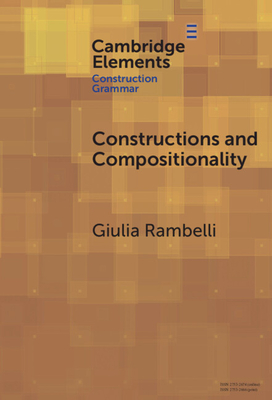
How do we understand any sentence, from the most ordinary to the most creative? The traditional assumption is that we rely on formal rules combining words (compositionality). However, psycho- and neuro-linguistic studies point to a linguistic representation model that aligns with the assumptions of Construction Grammar: there is no sharp boundary between stored sequences and productive patterns. Evidence suggests that interpretation alternates compositional (incremental) and noncompositional (global) strategies. Accordingly ...
Read More
How do we understand any sentence, from the most ordinary to the most creative? The traditional assumption is that we rely on formal rules combining words (compositionality). However, psycho- and neuro-linguistic studies point to a linguistic representation model that aligns with the assumptions of Construction Grammar: there is no sharp boundary between stored sequences and productive patterns. Evidence suggests that interpretation alternates compositional (incremental) and noncompositional (global) strategies. Accordingly, systematic processes of language productivity are explainable by analogical inferences rather than compositional operations: novel expressions are understood 'on the fly' by analogy with familiar ones. This Element discusses compositionality, alternative mechanisms in language processing, and explains why Construction Grammar is the most suitable approach for formalizing language comprehension.
Read Less
Add this copy of Constructions and Compositionality: Cognitive and to cart. $86.51, new condition, Sold by Ingram Customer Returns Center rated 5.0 out of 5 stars, ships from NV, USA, published 2025 by Cambridge University Press.
Add this copy of Constructions and Compositionality: Cognitive and to cart. $90.65, new condition, Sold by Just one more Chapter rated 4.0 out of 5 stars, ships from Miramar, FL, UNITED STATES, published 2025 by Cambridge University Press.