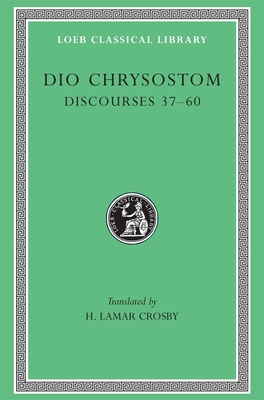
The man with the golden mouth. Dio Cocceianus Chrysostomus (AD ca. 40-ca. 120), of Prusa in Bithynia, Asia Minor, inherited with his brothers large properties and debts from his generous father Pasicrates. He became a skilled rhetorician hostile to philosophers. But in the course of his travels he went to Rome in Vespasian's reign (69-79) and was converted to Stoicism. Strongly critical of the emperor Domitian (81-96) he was about 82 banned by him from Italy and Bithynia and wandered in poverty, especially in lands ...
Read More
The man with the golden mouth. Dio Cocceianus Chrysostomus (AD ca. 40-ca. 120), of Prusa in Bithynia, Asia Minor, inherited with his brothers large properties and debts from his generous father Pasicrates. He became a skilled rhetorician hostile to philosophers. But in the course of his travels he went to Rome in Vespasian's reign (69-79) and was converted to Stoicism. Strongly critical of the emperor Domitian (81-96) he was about 82 banned by him from Italy and Bithynia and wandered in poverty, especially in lands north of the Aegean, as far as the Danube and the primitive Getae. In 97 he spoke publicly to Greeks assembled at Olympia, was welcomed at Rome by emperor Nerva (96-98), and returned to Prusa. Arriving again at Rome on an embassy of thanks about 98-99 he became a firm friend of emperor Trajan. In 102 he traveled to Alexandria and elsewhere. Involved in a lawsuit about plans to beautify Prusa at his own expense, he stated his case before the governor of Bithynia, Pliny the Younger, 111-112. The rest of his life is unknown. Nearly all of Dio's extant Discourses (or Orations) reflect political concerns (the most important of them dealing with affairs in Bithynia and affording valuable details about conditions in Asia Minor) or moral questions (mostly written in later life; they contain much of his best writing). Some philosophical and historical works, including one on the Getae, are lost. What survives of his achievement as a whole makes him prominent in the revival of Greek literature in the last part of the first century and the first part of the second. The Loeb Classical Library edition of Dio Chrysostom is in five volumes.
Read Less
Add this copy of Dio Chrysostom Vol. IV; Discourses 37-60 to cart. $28.00, good condition, Sold by Ancient World Books rated 5.0 out of 5 stars, ships from Toronto, ON, CANADA, published 1962 by William Heinemann & Harvard University Press.
Choose your shipping method in Checkout. Costs may vary based on destination.
Seller's Description:
Good in No Dust Jacket dust jacket. 0674994140. Scholar's name to ffep (A. R. Littlewood). Foxing to top of textblock. Ex-library copy with usual markings. Spotting to spine.; Loeb Classical Library No. 376; 4; 480 pages.
Add this copy of Discourses 37-60 to cart. $29.48, good condition, Sold by HPB-Red rated 5.0 out of 5 stars, ships from Dallas, TX, UNITED STATES, published 1946 by Harvard University Press.
Choose your shipping method in Checkout. Costs may vary based on destination.
Seller's Description:
Good. Connecting readers with great books since 1972! Used textbooks may not include companion materials such as access codes, etc. May have some wear or writing/highlighting. We ship orders daily and Customer Service is our top priority!
Add this copy of Dio Chrysostom: Discourses 37-60 (Loeb Classical to cart. $105.50, new condition, Sold by GridFreed rated 5.0 out of 5 stars, ships from San Diego, CA, UNITED STATES, published 1946 by Harvard University Press.
Add this copy of Dio Chrysostom IV: Discourses 37-60. Loeb Classical to cart. $45.00, very good condition, Sold by The Bookseller rated 4.0 out of 5 stars, ships from Edmonton, AB, CANADA, published 1989 by Harvard University Press.
Add this copy of Discourses 37? 60 to cart. $63.89, good condition, Sold by Bonita rated 4.0 out of 5 stars, ships from Santa Clarita, CA, UNITED STATES, published 1946 by Harvard University Press.
Add this copy of Discourses 37? 60 to cart. $98.58, new condition, Sold by Just one more Chapter rated 4.0 out of 5 stars, ships from Miramar, FL, UNITED STATES, published 1946 by Harvard University Press.