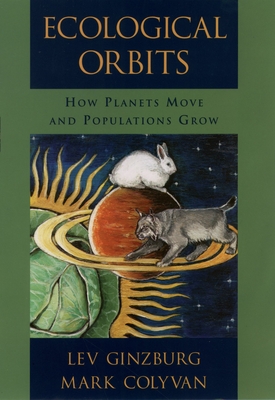
A famous ecologist and a philosopher of science team up to offer a fresh new approach to population biology and ecology. Challenging the traditionally accepted Lotka-Volterra model, which is based on predator-prey interactions, this new model emphasizes maternal effects, specifically the significance of a mother's interest in the success of her female offspring. Read More
A famous ecologist and a philosopher of science team up to offer a fresh new approach to population biology and ecology. Challenging the traditionally accepted Lotka-Volterra model, which is based on predator-prey interactions, this new model emphasizes maternal effects, specifically the significance of a mother's interest in the success of her female offspring. Read Less
Add this copy of Ecological Orbits: How Planets Move and Populations to cart. $41.13, like new condition, Sold by GreatBookPricesUK5 rated 5.0 out of 5 stars, ships from Castle Donington, DERBYSHIRE, UNITED KINGDOM, published 2004 by Oxford University Press.
Choose your shipping method in Checkout. Costs may vary based on destination.
Seller's Description:
Fine. Sewn binding. Cloth over boards. 184 p. Contains: Unspecified. In Stock. 100% Money Back Guarantee. Brand New, Perfect Condition, allow 4-14 business days for standard shipping. To Alaska, Hawaii, U.S. protectorate, P.O. box, and APO/FPO addresses allow 4-28 business days for Standard shipping. No expedited shipping. All orders placed with expedited shipping will be cancelled. Over 3, 000, 000 happy customers.
Add this copy of Ecological Orbits: How Planets Move and Populations to cart. $44.33, new condition, Sold by GreatBookPricesUK5 rated 5.0 out of 5 stars, ships from Castle Donington, DERBYSHIRE, UNITED KINGDOM, published 2004 by Oxford University Press.
Choose your shipping method in Checkout. Costs may vary based on destination.
Seller's Description:
New. Sewn binding. Cloth over boards. 184 p. Contains: Unspecified. In Stock. 100% Money Back Guarantee. Brand New, Perfect Condition, allow 4-14 business days for standard shipping. To Alaska, Hawaii, U.S. protectorate, P.O. box, and APO/FPO addresses allow 4-28 business days for Standard shipping. No expedited shipping. All orders placed with expedited shipping will be cancelled. Over 3, 000, 000 happy customers.
Add this copy of Ecological Orbits to cart. $46.69, new condition, Sold by Books2anywhere rated 5.0 out of 5 stars, ships from Fairford, GLOUCESTERSHIRE, UNITED KINGDOM, published 2004 by Oxford University Press.
Choose your shipping method in Checkout. Costs may vary based on destination.
Seller's Description:
PLEASE NOTE, WE DO NOT SHIP TO DENMARK. New Book. Shipped from UK in 4 to 14 days. Established seller since 2000. Please note we cannot offer an expedited shipping service from the UK.
Add this copy of Ecological Orbits: How Planets Move and Populations to cart. $47.28, new condition, Sold by Ria Christie Books rated 5.0 out of 5 stars, ships from Uxbridge, MIDDLESEX, UNITED KINGDOM, published 2004 by Oxford University Press.
Add this copy of Ecological Orbits to cart. $56.60, new condition, Sold by Kennys.ie rated 5.0 out of 5 stars, ships from Galway, IRELAND, published 2004 by Oxford University Press.
Choose your shipping method in Checkout. Costs may vary based on destination.
Seller's Description:
New. Proposes a fresh approach to population biology and ecology. This book proposes and develops an inertial view of population growth, taking note of acceleration, or rate of change of the growth rate between consecutive generations. It is useful for population biologists, ecological modellers, and theoretical biologists and philosophers of science. Num Pages: 184 pages, 15 halftones & 18 line illus. BIC Classification: PS. Category: (P) Professional & Vocational. Dimension: 215 x 143 x 16. Weight in Grams: 344. 2003. Hardback.....We ship daily from our Bookshop.
Add this copy of Ecological Orbits: How Planets Move and Populations to cart. $56.95, new condition, Sold by Booksplease rated 4.0 out of 5 stars, ships from Southport, MERSEYSIDE, UNITED KINGDOM, published 2004 by Oxford University Press.