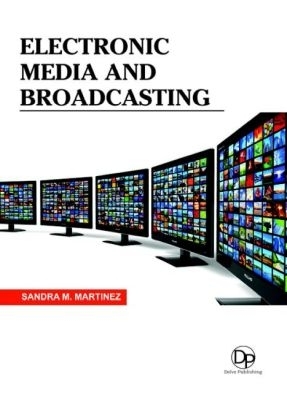
Electronic media are media that use electronics or electromechanical audience to access the content. This is in contrast to static media (mainly print media), which today are most often created electronically, but do not require electronics to be accessed by the end user in the printed form. Broadcasting is the distribution of audio and/or video content or other messages to a dispersed audience via any electronic mass communications medium, but typically one using the electromagnetic spectrum (radio waves), in a one-to-many ...
Read More
Electronic media are media that use electronics or electromechanical audience to access the content. This is in contrast to static media (mainly print media), which today are most often created electronically, but do not require electronics to be accessed by the end user in the printed form. Broadcasting is the distribution of audio and/or video content or other messages to a dispersed audience via any electronic mass communications medium, but typically one using the electromagnetic spectrum (radio waves), in a one-to-many model. Broadcasting began with AM radio, which came into popular use around 1920 with the spread of vacuum tube radio transmitters and receivers. Before this, all forms of electronic communication (early radio, telephone, and telegraph) were one-to-one, with the message intended for a single recipient. Security issues may arise during broadcasting and lead to data loss if a network is attacked by intruders. In non-networking or electronic broadcasting, the term broadcasting denotes the transfer of audio and video data between nodes and devices. Originally all broadcasting was composed of analog signals using analog transmission techniques but in the 2000s, broadcasters have switched to digital signals using digital transmission. In general usage, broadcasting most frequently refers to the transmission of information and entertainment programming from various sources to the general public. A broadcast may be distributed through several physical means. If coming directly from the radio studio at a single station or television station, it is simply sent through the studio/transmitter link to the transmitter and hence from the television antenna located on the radio masts and towers out to the world. Programming may also come through a communications satellite, played either live or recorded for later transmission. Networks of stations may simulcast the same programming at the same time, originally via microwave link, now usually by satellite. Broadcasting focuses on getting a message out and it is up to the general public to do what they wish with it.
Read Less
Add this copy of Electronic Media and Broadcasting to cart. $111.19, new condition, Sold by discount_scientific_books rated 5.0 out of 5 stars, ships from Sterling Heights, MI, UNITED STATES, published 2016 by Delve Publishing.
Add this copy of Electronic Media and Broadcasting to cart. $114.94, new condition, Sold by Basi6 International rated 5.0 out of 5 stars, ships from Irving, TX, UNITED STATES, published 2016 by Delve Publishing.
Add this copy of Electronic Media and Broadcasting to cart. $115.94, new condition, Sold by Basi6 International rated 5.0 out of 5 stars, ships from Irving, TX, UNITED STATES, published 2016 by Delve Publishing.
Add this copy of Electronic Media and Broadcasting to cart. $103.24, new condition, Sold by Educational Media Centre rated 4.0 out of 5 stars, ships from New Delhi, DELHI, INDIA, published 2016 by Delve Publishing.
Add this copy of Electronic Media and Broadcasting to cart. $103.43, new condition, Sold by Educational Media Centre rated 4.0 out of 5 stars, ships from New Delhi, DELHI, INDIA, published 2016 by Delve Publishing.