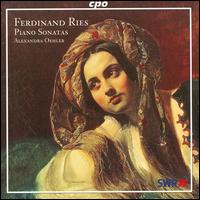
Ferdinand Ries was one of the few real protégés of the loner Beethoven. Beethoven's influence certainly shows in the piano music here, written during the first decade of the nineteenth century. The early to middle transitional Beethoven provided the models for Ries; anyone expecting an undiscovered "Waldstein" Sonata will naturally enough be disappointed, but the "Moonlight" certainly exerted its pull on Beethoven's Bonn-born student in its free treatment of the piano sonata's movement order. Two sonatas, both hopefully ...
Read More
Ferdinand Ries was one of the few real protégés of the loner Beethoven. Beethoven's influence certainly shows in the piano music here, written during the first decade of the nineteenth century. The early to middle transitional Beethoven provided the models for Ries; anyone expecting an undiscovered "Waldstein" Sonata will naturally enough be disappointed, but the "Moonlight" certainly exerted its pull on Beethoven's Bonn-born student in its free treatment of the piano sonata's movement order. Two sonatas, both hopefully designated "grande," appear here, and each has an unusual movement. The finale of the Grande Sonate Fantaisie "L'infortune" in F sharp minor, Op. 26 (note the terminological similarity to the "Moonlight") rambles and does not support its more-than-13-minute length. With the odd Tempo di Minuetto second movement of the Grande Sonate in D major, Op. 9, however, Ries hits on something original. It is far from a conventional minuet, and even from the barkingly funny minuets Beethoven wrote...
Read Less
Add this copy of Ries: Piano Sonatas to cart. $52.36, new condition, Sold by insomniacsonline rated 5.0 out of 5 stars, ships from South Hackensack, NJ, UNITED STATES, published 2006 by CPO.
Choose your shipping method in Checkout. Costs may vary based on destination.
Seller's Description:
New. Size: 5x0x4; Buy from insomniacs! We dont sleep until your order is shipped! Professional packaging, same day shipping on most orders. View our feedback and buy with confidence.