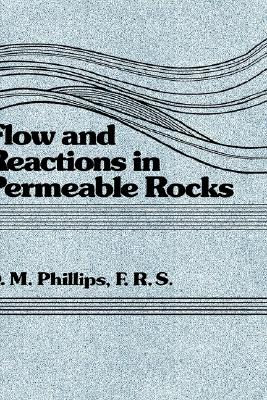
The formation of ore deposits and the patterns of mineral alteration in rocks frequently involves the transport of large amounts of dissolved solids, sometimes transiently, but often over long periods of time. Knowing or suspecting this, we logically seek to resolve several questions: What are the large- and small-scale patterns of flow in geological materials? What is the direction and rate of flow in a given structure? What factors control the rates of chemical reaction within the rocks? What governs the dissolution of ... Read More
The formation of ore deposits and the patterns of mineral alteration in rocks frequently involves the transport of large amounts of dissolved solids, sometimes transiently, but often over long periods of time. Knowing or suspecting this, we logically seek to resolve several questions: What are the large- and small-scale patterns of flow in geological materials? What is the direction and rate of flow in a given structure? What factors control the rates of chemical reaction within the rocks? What governs the dissolution of materials in some regions and their deposition in other areas that, over eons, leads to the distribution of minerals we see today? The search for answers to these issues involves a combination of approaches and subjects that includes geochemistry, structural geology, and fluid mechanics. In Flow and Reactions in Permeable Rocks, Dr. Owen Phillips provides the first book-length work that connects these different fields of study and applies them to the problem of flow and flow-controlled reaction in rocks. The author begins by specifying the general physical and chemical principles that govern fluid flow and chemical reactions in rocks. He then develops the theoretical underpinnings for a variety of different patterns of flow and for the three basic types of flow-controlled reaction: fronts, gradient reactions, and reactions in mixing zones. In the next chapter he explores some conditions for stability and instability in fluid flow, for instance the conditions under which one state of flow pattern spontaneously evolves into another. Finally, Dr. Phillips describes in detail the two great driving forces of large-scale fluid circulation in rocks: pressure differences and thermal convection. Typical geological examples are given and, wherever possible, compared to numerical results or field observations. The analytical developments require some familiarity with college-level mathematics, but derivations are easy to follow or may even be skipped by the trusting reader. Read Less
Add this copy of Flow and Reactions in Permeable Rocks to cart. $52.20, good condition, Sold by Phatpocket Limited rated 5.0 out of 5 stars, ships from Waltham Abbey, ESSEX, UNITED KINGDOM, published 1991 by Cambridge University Press.
Choose your shipping method in Checkout. Costs may vary based on destination.
Seller's Description:
Good. Ships from UK in 48 hours or less (usually same day). Your purchase helps support Sri Lankan Children's Charity 'The Rainbow Centre'. Ex-library, so some stamps and wear, but in good overall condition. 100% money back guarantee. We are a world class secondhand bookstore based in Hertfordshire, United Kingdom and specialize in high quality textbooks across an enormous variety of subjects. We aim to provide a vast range of textbooks, rare and collectible books at a great price. Our donations to The Rainbow Centre have helped provide an education and a safe haven to hundreds of children who live in appalling conditions. We provide a 100% money back guarantee and are dedicated to providing our customers with the highest standards of service in the bookselling industry.
Add this copy of Flow and Reactions in Permeable Rocks to cart. $82.46, good condition, Sold by Bonita rated 4.0 out of 5 stars, ships from Santa Clarita, CA, UNITED STATES, published 1991 by Cambridge University Press.
Add this copy of Flow and Reactions in Permeable Rocks to cart. $121.14, new condition, Sold by Just one more Chapter rated 4.0 out of 5 stars, ships from Miramar, FL, UNITED STATES, published 1991 by Cambridge University Press.