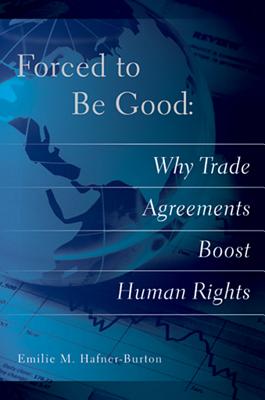
Preferential trade agreements have become common ways to protect or restrict access to national markets in products and services. The United States has signed trade agreements with almost two dozen countries as close as Mexico and Canada and as distant as Morocco and Australia. The European Union has done the same. In addition to addressing economic issues, these agreements also regulate the protection of human rights. In Forced to Be Good Emilie M. Hafner-Burton tells the story of the politics of such agreements and of the ...
Read More
Preferential trade agreements have become common ways to protect or restrict access to national markets in products and services. The United States has signed trade agreements with almost two dozen countries as close as Mexico and Canada and as distant as Morocco and Australia. The European Union has done the same. In addition to addressing economic issues, these agreements also regulate the protection of human rights. In Forced to Be Good Emilie M. Hafner-Burton tells the story of the politics of such agreements and of the ways in which governments pursue market integration policies that advance their own political interests, including human rights. How and why do global norms for social justice become international regulations linked to seemingly unrelated issues, such as trade? Hafner-Burton finds that the process has been unconventional. Efforts by human rights advocates and labor unions to spread human rights ideals, for example, do not explain why American and European governments employ preferential trade agreements to protect human rights. Instead, most of the regulations protecting human rights are codified in global moral principles and laws only because they serve policymakers' interests in accumulating power or resources or solving other problems. Otherwise, demands by moral advocates are tossed aside. And, as Hafner-Burton shows, even the inclusion of human rights protections in trade agreements is no guarantee of real change, because many of the governments that sign on to fair trade regulations oppose such protections and do not intend to force their implementation. Ultimately, Hafner-Burton finds that, despite the difficulty of enforcing good regulations and the less-than-noble motives for including them, trade agreements that include human rights provisions have made a positive difference in the lives of some of the people they are intended-on paper, at least-to protect.
Read Less
Add this copy of Forced to Be Good: Why Trade Agreements Boost Human to cart. $42.33, very good condition, Sold by Books From California rated 4.0 out of 5 stars, ships from Simi Valley, CA, UNITED STATES, published 2009 by Cornell University Press.
Add this copy of Forced to Be Good to cart. $59.67, new condition, Sold by Books2anywhere rated 5.0 out of 5 stars, ships from Fairford, GLOUCESTERSHIRE, UNITED KINGDOM, published 2009 by MB-Cornell University Press.
Choose your shipping method in Checkout. Costs may vary based on destination.
Seller's Description:
PLEASE NOTE, WE DO NOT SHIP TO DENMARK. New Book. Shipped from UK in 4 to 14 days. Established seller since 2000. Please note we cannot offer an expedited shipping service from the UK.
Add this copy of Forced to Be Good: Why Trade Agreements Boost Human to cart. $67.96, new condition, Sold by SellingTales rated 5.0 out of 5 stars, ships from Belvidere, NJ, UNITED STATES, published 2009 by Cornell University Press.
Add this copy of Forced to Be Good: Why Trade Agreements Boost Human to cart. $81.17, good condition, Sold by Bonita rated 4.0 out of 5 stars, ships from Santa Clarita, CA, UNITED STATES, published 2009 by Cornell University Press.