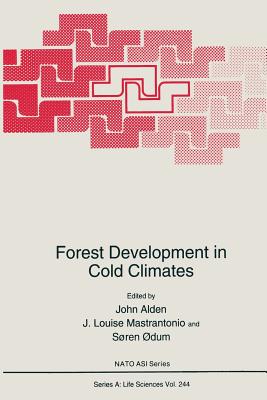
As forests decline in temperate and tropical climates, highly-developed countries and those striving for greater economic and social benefits are beginning to utilize marginal forests of high-latitude and mountainous regions for resources to satisfy human needs. The benefits of marginal forests range from purely aesthetic to providing resources for producing many goods and services demanded by a growing world population. Increased demands for forest resources and amenities and recent warming of high latitude climates have ...
Read More
As forests decline in temperate and tropical climates, highly-developed countries and those striving for greater economic and social benefits are beginning to utilize marginal forests of high-latitude and mountainous regions for resources to satisfy human needs. The benefits of marginal forests range from purely aesthetic to providing resources for producing many goods and services demanded by a growing world population. Increased demands for forest resources and amenities and recent warming of high latitude climates have generated interest in reforestation and afforestation of marginal habitats in cold regions. Afforestation of treeless landscapes improves the environment for human habitation and provides for land use and economic prosperity. Trees are frequently planted in cold climates to rehabilitate denuded sites, for the amenity of homes and villages, and for wind shelter, recreation, agroforestry, and industrial uses. In addition, forests in cold climates reduce the albedo of the earth's surface in winter, and in summer they are small but significant long-lived sinks for atmospheric carbon dioxide. Finally, growth and reproductive success of forests at their geographic limits are sensitive indices of climatic change. As efforts to adapt forests to cold climates increase, however, new afforestation problems arise and old ones intensify. Austral, northern, and altitudinal tree limits are determined by many different factors. Current hypotheses for high-latitude tree limits are based on low growing-season temperatures that inhibit plant development and reproduction.
Read Less
Add this copy of Forest Development in Cold Climates to cart. $158.08, new condition, Sold by Educational Media Centre rated 4.0 out of 5 stars, ships from New Delhi, DELHI, INDIA, published 2013 by Springer-Verlag New York Inc..
Add this copy of Forest Development in Cold Climates to cart. $169.57, new condition, Sold by Basi6 International rated 5.0 out of 5 stars, ships from Irving, TX, UNITED STATES, published 2013 by Springer-Verlag New York Inc..
Add this copy of Forest Development in Cold Climates to cart. $182.31, new condition, Sold by Educational Media Centre rated 4.0 out of 5 stars, ships from New Delhi, DELHI, INDIA, published 2013 by Springer-Verlag New York Inc..
Add this copy of Forest Development in Cold Climates to cart. $215.66, new condition, Sold by Ingram Customer Returns Center rated 5.0 out of 5 stars, ships from NV, USA, published 2013 by Springer-Verlag New York Inc..
Add this copy of Forest Development in Cold Climates to cart. $263.68, new condition, Sold by Ria Christie Books rated 5.0 out of 5 stars, ships from Uxbridge, MIDDLESEX, UNITED KINGDOM, published 2013 by Springer-Verlag New York Inc..
Add this copy of Forest Development in Cold Climates to cart. $158.08, new condition, Sold by Educational Media Centre rated 4.0 out of 5 stars, ships from New Delhi, DELHI, INDIA, published 1993 by Springer.
Add this copy of Forest Development in Cold Climates to cart. $169.57, new condition, Sold by Basi6 International rated 5.0 out of 5 stars, ships from Irving, TX, UNITED STATES, published 1993 by Springer.
Add this copy of Forest Development in Cold Climates to cart. $182.31, new condition, Sold by Educational Media Centre rated 4.0 out of 5 stars, ships from New Delhi, DELHI, INDIA, published 1993 by Springer.
Add this copy of Forest Development in Cold Climates to cart. $215.66, new condition, Sold by Ingram Customer Returns Center rated 5.0 out of 5 stars, ships from NV, USA, published 1993 by Springer.