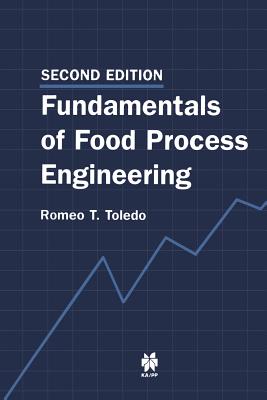
Ten years after the publication of the first edition of Flllldmntntais of Food Process Engineering, there have been significant changes in both food science education and the food industry itself. Students now in the food science curric- ulum are generally better prepared mathematically than their counterparts two decades ago. The food science curriculum in most schools in the United States has split into science and business options, with students in the science option following the Institute of Food Technologists' minimum ...
Read More
Ten years after the publication of the first edition of Flllldmntntais of Food Process Engineering, there have been significant changes in both food science education and the food industry itself. Students now in the food science curric- ulum are generally better prepared mathematically than their counterparts two decades ago. The food science curriculum in most schools in the United States has split into science and business options, with students in the science option following the Institute of Food Technologists' minimum requirements. The minimum requirements include the food engineering course, thus students en- rolled in food engineering are generally better than average, and can be chal- lenged with more rigor in the course material. The food industry itself has changed. Traditionally, the food industry has been primarily involved in the canning and freezing of agriCUltural commodi- ties, and a company's operations generally remain within a single commodity. Now, the industry is becoming more diversified, with many companies involved in operations involving more than one type of commodity. A number of for- mulated food products are now made where the commodity connection becomes obscure. The ability to solve problems is a valued asset in a technologist, and often, solving problems involves nothing more than applying principles learned in other areas to the problem at hand. A principle that may have been commonly used with one commodity may also be applied to another commodity to produce unique products.
Read Less
Add this copy of Fundamentals of Food Process Engineering to cart. $60.65, new condition, Sold by Ingram Customer Returns Center rated 5.0 out of 5 stars, ships from NV, USA, published 2012 by Springer.
Add this copy of Fundamentals of Food Process Engineering to cart. $66.33, new condition, Sold by GreatBookPrices rated 4.0 out of 5 stars, ships from Columbia, MD, UNITED STATES, published 2012 by Springer.
Edition:
2nd Softcover Reprint of the 2nd 1991 edition
Publisher:
Springer
Published:
2012
Language:
English
Alibris ID:
17988007801
Shipping Options:
Standard Shipping: $4.87
Choose your shipping method in Checkout. Costs may vary based on destination.
Seller's Description:
New. Trade paperback (US). Glued binding. 602 p. Contains: Unspecified. In Stock. 100% Money Back Guarantee. Brand New, Perfect Condition, allow 4-14 business days for standard shipping. To Alaska, Hawaii, U.S. protectorate, P.O. box, and APO/FPO addresses allow 4-28 business days for Standard shipping. No expedited shipping. All orders placed with expedited shipping will be cancelled. Over 3, 000, 000 happy customers.
Add this copy of Fundamentals of Food Process Engineering to cart. $89.47, good condition, Sold by Bonita rated 4.0 out of 5 stars, ships from Santa Clarita, CA, UNITED STATES, published 2012 by Springer.