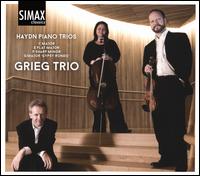
Joseph Haydn's piano trios are generally neglected, for the reason that many of them are little more than simple piano sonatas with violin and cello parts added to maximize the commercial potential for family music-making. The late ones, though, have more happening, especially in the piano parts. The ones written in London, for two talented female pianists (one of whom may have been Haydn's temporary squeeze), would certainly have been known to Beethoven, who went beyond them. But the Grieg Trio makes a case for these works ...
Read More
Joseph Haydn's piano trios are generally neglected, for the reason that many of them are little more than simple piano sonatas with violin and cello parts added to maximize the commercial potential for family music-making. The late ones, though, have more happening, especially in the piano parts. The ones written in London, for two talented female pianists (one of whom may have been Haydn's temporary squeeze), would certainly have been known to Beethoven, who went beyond them. But the Grieg Trio makes a case for these works in its own right. One movement from the Piano Trio in G major, Hob. 15/25, is a famous piece: the "gypsy" finale, which incorporates actual tunes of the Hungarian genre known as verbunkos . The Grieg players give it a lively and full-blooded performance. But the real attraction of these trios is the slow movements, wherein Haydn carried out some of the most daring harmonic experiments of his old age. Consider and sample the "Andante con moto" slow movement of the Piano Trio in...
Read Less