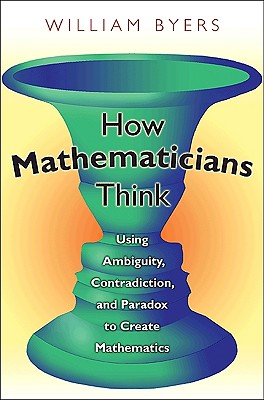
To many outsiders, mathematicians appear to think like computers, grimly grinding away with a strict formal logic and moving methodically--even algorithmically--from one black-and-white deduction to another. Yet mathematicians often describe their most important breakthroughs as creative, intuitive responses to ambiguity, contradiction, and paradox. A unique examination of this less-familiar aspect of mathematics, How Mathematicians Think reveals that mathematics is a profoundly creative activity and not just a body of ...
Read More
To many outsiders, mathematicians appear to think like computers, grimly grinding away with a strict formal logic and moving methodically--even algorithmically--from one black-and-white deduction to another. Yet mathematicians often describe their most important breakthroughs as creative, intuitive responses to ambiguity, contradiction, and paradox. A unique examination of this less-familiar aspect of mathematics, How Mathematicians Think reveals that mathematics is a profoundly creative activity and not just a body of formalized rules and results. Nonlogical qualities, William Byers shows, play an essential role in mathematics. Ambiguities, contradictions, and paradoxes can arise when ideas developed in different contexts come into contact. Uncertainties and conflicts do not impede but rather spur the development of mathematics. Creativity often means bringing apparently incompatible perspectives together as complementary aspects of a new, more subtle theory. The secret of mathematics is not to be found only in its logical structure. The creative dimensions of mathematical work have great implications for our notions of mathematical and scientific truth, and How Mathematicians Think provides a novel approach to many fundamental questions. Is mathematics objectively true? Is it discovered or invented? And is there such a thing as a "final" scientific theory? Ultimately, How Mathematicians Think shows that the nature of mathematical thinking can teach us a great deal about the human condition itself.
Read Less
Add this copy of How Mathematicians Think: Using Ambiguity, to cart. $31.79, like new condition, Sold by GreatBookPricesUK5 rated 5.0 out of 5 stars, ships from Castle Donington, DERBYSHIRE, UNITED KINGDOM, published 2010 by Princeton University Press.
Choose your shipping method in Checkout. Costs may vary based on destination.
Seller's Description:
Fine. Trade paperback (US). Glued binding. 424 p. In Stock. 100% Money Back Guarantee. Brand New, Perfect Condition, allow 4-14 business days for standard shipping. To Alaska, Hawaii, U.S. protectorate, P.O. box, and APO/FPO addresses allow 4-28 business days for Standard shipping. No expedited shipping. All orders placed with expedited shipping will be cancelled. Over 3, 000, 000 happy customers.
Add this copy of How Mathematicians Think: Using Ambiguity, to cart. $10.93, good condition, Sold by Blue Vase Books rated 5.0 out of 5 stars, ships from Interlochen, MI, UNITED STATES, published 2010 by Princeton University Press.
Choose your shipping method in Checkout. Costs may vary based on destination.
Seller's Description:
The item shows wear from consistent use but it remains in good condition and works perfectly. All pages and cover are intact including the dust cover if applicable. Spine may show signs of wear. Pages may include limited notes and highlighting. May NOT include discs access code or other supplemental materials.
Add this copy of How Mathematicians Think: Using Ambiguity, to cart. $12.00, good condition, Sold by HPB-Red rated 5.0 out of 5 stars, ships from Dallas, TX, UNITED STATES, published 2007 by Princeton University Press.
Choose your shipping method in Checkout. Costs may vary based on destination.
Seller's Description:
Good. Connecting readers with great books since 1972! Used textbooks may not include companion materials such as access codes, etc. May have some wear or writing/highlighting. We ship orders daily and Customer Service is our top priority!
Add this copy of How Mathematicians Think: Using Ambiguity, to cart. $19.39, Sold by Zubal Books rated 5.0 out of 5 stars, ships from Cleveland, OH, UNITED STATES, published 2010 by Princeton University Press.
Choose your shipping method in Checkout. Costs may vary based on destination.
Seller's Description:
*Price HAS BEEN REDUCED by 10% until Monday, June 15 (SALE item)* 424 pp., paperback, new. -If you are reading this, this item is actually (physically) in our stock and ready for shipment once ordered. We are not bookjackers. Buyer is responsible for any additional duties, taxes, or fees required by recipient's country.
Add this copy of How Mathematicians Think: Using Ambiguity, to cart. $21.53, very good condition, Sold by Solr Books rated 5.0 out of 5 stars, ships from Lincolnwood, IL, UNITED STATES, published 2010 by Princeton University Press.
Add this copy of How Mathematicians Think: Using Ambiguity, to cart. $23.04, very good condition, Sold by Lake Country Books rated 5.0 out of 5 stars, ships from Excelsior, MN, UNITED STATES, published 2010 by Princeton University Press.
Choose your shipping method in Checkout. Costs may vary based on destination.
Seller's Description:
Near Fine in None as issued jacket. Size: 6x1x9; Excellent paperback textbook. Clean, solid with unmarked text. Cover has mild surface and edge wear. Binding is tight and square; no creases to spine or cover. Books, box sets, and items other than standard jewel case CDs and DVDs that sell for $9 or more ship in a box; under $9 in a bubble mailer. Expedited and international orders may ship in a flat rate envelope rather than a box due to cost constraints. All US-addressed items ship with complimentary delivery confirmation.
Add this copy of How Mathematicians Think: Using Ambiguity Contradiction to cart. $27.89, good condition, Sold by BookHolders rated 5.0 out of 5 stars, ships from Gambrills, MD, UNITED STATES, published 2007 by Princeton University Press.