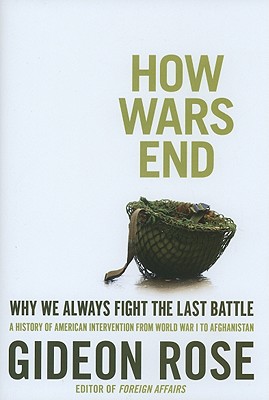
From World War I to Iraq, historian Rose argues that America has failed to find the proper peace, and that failure has shaped the modern world.
Read More
From World War I to Iraq, historian Rose argues that America has failed to find the proper peace, and that failure has shaped the modern world.
Read Less
Add this copy of How Wars End: Why We Always Fight the Last Battle to cart. $9.89, good condition, Sold by Blue Vase Books rated 5.0 out of 5 stars, ships from Interlochen, MI, UNITED STATES, published 2010 by Simon & Schuster.
Choose your shipping method in Checkout. Costs may vary based on destination.
Seller's Description:
Former library book with the usual stamps stickers and labels. The item shows wear from consistent use but it remains in good condition and works perfectly. All pages and cover are intact including the dust cover if applicable. Spine may show signs of wear. Pages may include limited notes and highlighting. May NOT include discs access code or other supplemental materials.
Add this copy of How Wars End: Why We Always Fight the Last Battle to cart. $12.63, good condition, Sold by Wonder Book - Member ABAA/ILAB rated 5.0 out of 5 stars, ships from Frederick, MD, UNITED STATES, published 2010 by Simon & Schuster.
Choose your shipping method in Checkout. Costs may vary based on destination.
Seller's Description:
Good. Good condition. Good dust jacket. A copy that has been read but remains intact. May contain markings such as bookplates, stamps, limited notes and highlighting, or a few light stains.
Add this copy of How Wars End: Why We Always Fight the Last Battle; a to cart. $72.00, very good condition, Sold by Ground Zero Books, Ltd. rated 5.0 out of 5 stars, ships from Silver Spring, MD, UNITED STATES, published 2010 by Simon & Schuster.
Choose your shipping method in Checkout. Costs may vary based on destination.
Seller's Description:
Jack Sullivan (Jacket photograph) and Wendi Rose ( Very good in Very good jacket. [10], 413, [5] pages. Endnotes. Index. DJ has slight wear and soiling. This is a Council on Foreign Relations book. Gideon Rose is a former editor of Foreign Affairs and a member of the Council on Foreign Relations. He served as Associate Director for Near East and South Asian Affairs on the staff of the National Security Council from 1994 to 1995 under the Clinton Administration. In 1985 Rose was appointed assistant editor of The National Interest, a foreign policy quarterly. He then went on to hold a similar position at a domestic quarterly, The Public Interest. In 1996, he joined Princeton University's Politics Department as a lecturer on American foreign policy and then held a similar position at the School of International and Public Affairs (SIPA) at Columbia University, where he currently teaches as an adjunct professor in the department of political science. Rose was an Olin Senior Fellow and the Deputy Director of National Security Studies at the Council on Foreign Relations from 1995 to 2000, before he was appointed managing editor of Foreign Affairs to replace Fareed Zakaria. On June 3, 2010, it was announced that Rose would be succeeding James F. Hoge, Jr. as the editor of Foreign Affairs. He took up the position on October 1, 2010. Rose left as editor in January 2021 and joined the Council on Foreign Relations' think tank to write a book. IN 1991 the United States trounced the Iraqi army in battle only to stumble blindly into postwar turmoil. Then in 2003 the United States did it again. How could this happen? How could the strongest power in modern history fight two wars against the same opponent in just over a decade, win lightning victories both times, and yet still be woefully unprepared for the aftermath? Because Americans always forget the political aspects of war. Time and again, argues Gideon Rose in this penetrating look at American wars over the last century, our leaders have focused more on beating up the enemy than on creating a stable postwar environment. What happened in Iraq was only the most prominent example of this phenomenon, not an exception to the rule. Woodrow Wilson fought a war to make the world safe for democracy but never asked himself what democracy actually meant and then dithered as Germany slipped into chaos. Franklin Roosevelt resolved not to repeat Wilson's mistakes but never considered what would happen to his own elaborate postwar arrangements should America's wartime marriage of convenience with Stalin break up after the shooting stopped. The Truman administration casually established voluntary prisoner repatriation as a key American war aim in Korea without exploring whether it would block an armistice, which it did for almost a year and a half. The Kennedy and Johnson administrations dug themselves deeper and deeper into Vietnam without any plans for how to get out, making it impossible for Nixon and Ford to escape unscathed. And the list goes on. Drawing on vast research, including extensive interviews with participants in recent wars, Rose re-creates the choices that presidents and their advisers have confronted during the final stages of each major conflict from World War I through Iraq. He puts readers in the room with U.S. officials as they make decisions that affect millions of lives and shape the modern world, seeing what they saw, hearing what they heard, feeling what they felt. American leaders, Rose argues, have repeatedly ignored the need for careful postwar planning. But they can and must do a better job next time around, making the creation of a stable and sustainable local political outcome the goal of all wartime plans, rather than an afterthought to be dealt with once the "real" military work is over.
Add this copy of How Wars End: Why We Always Fight the Last Battle to cart. $105.50, new condition, Sold by GridFreed rated 5.0 out of 5 stars, ships from San Diego, CA, UNITED STATES, published 2010 by Simon & Schuster.
Add this copy of How Wars End: Why We Always Fight the Last Battle to cart. $9.88, like new condition, Sold by ThriftBooks-Baltimore rated 4.0 out of 5 stars, ships from Halethorpe, MD, UNITED STATES, published 2010 by Simon & Schuster.
Add this copy of How Wars End: Why We Always Fight the Last Battle to cart. $9.88, very good condition, Sold by ThriftBooks-Baltimore rated 4.0 out of 5 stars, ships from Halethorpe, MD, UNITED STATES, published 2010 by Simon & Schuster.
Add this copy of How Wars End: Why We Always Fight the Last Battle to cart. $9.88, good condition, Sold by ThriftBooks-Baltimore rated 4.0 out of 5 stars, ships from Halethorpe, MD, UNITED STATES, published 2010 by Simon & Schuster.
Add this copy of How Wars End: Why We Always Fight the Last Battle to cart. $9.91, very good condition, Sold by ThriftBooks-Dallas rated 4.0 out of 5 stars, ships from Dallas, TX, UNITED STATES, published 2010 by Simon & Schuster.