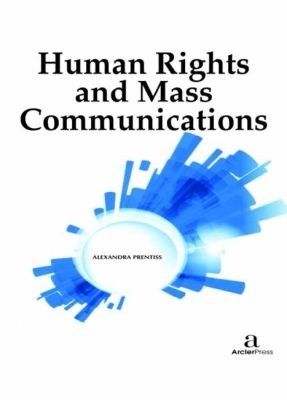
The communication of complex events is a uniquely human activity. Information sharing is the basis for all social interactions; the fabric of society is interwoven with and inseparable from communication. The ability to express oneself could be, and indeed is by many, considered a fundamental human right. However, this right is curtailed in certain places. It is up to those outside of these restrictive societies to report to the wider public violations of human rights. Therefore, there are two separate but equally critical ...
Read More
The communication of complex events is a uniquely human activity. Information sharing is the basis for all social interactions; the fabric of society is interwoven with and inseparable from communication. The ability to express oneself could be, and indeed is by many, considered a fundamental human right. However, this right is curtailed in certain places. It is up to those outside of these restrictive societies to report to the wider public violations of human rights. Therefore, there are two separate but equally critical components of the relationship between mass communication and human rights. The first is the idea that the freedom to communicate, in whatever form one chooses, is not only essential to the workings of society, but a fundamental human right. The second is the notion that human rights issues must be communicated to the public when those whose rights have been violated are unable to communicate themselves - it is up to journalists, non-governmental organizations and citizen journalists on social media to expose these issues. Part 1: As the glue that binds societies together, communication has evolved to signal distress as well as joy. When that glue is dissolved by those who have the power to curtail freedom of speech, voices go unheard. Distress signals are not heard by those who are in a position to effect change.We will begin this discussion with an examination of the international legal situation governing the right to communicate, the politics of which has hampered its becoming a global human right. We will then delve into case studies demonstrating where and how freedom of expression has been curtailed. While we often think of censorship and freedom of expression as a thing of the past, it will be shown that the opposite is often true; once liberal countries are becoming more restrictive. For example, there has been a surprising decline of freedom of speech and an increase in official censorship in once relatively liberal Thailand since the 2000s. Press freedom has evolved in South Africa since the abolition of apartheid in 1994, but this analysis shows another country in which restrictions are again becoming more severe. In Afghanistan, the impediments to freedom of speech are manifold, as Khalvatgar (2014) illustrates. It is perhaps unsurprising that, in addition to traditional media, social media is alsofficensored in certain places; the case of China's blocking of Twitter and Facebook is especially troubling given its large population and role in the international community. As the case study from Nepal demonstrates, it is often up to the audience to intervene when the victims of human rights violations cannot surmount the obstacles in place. While the press has traditionally been the medium via which news travels, in societies where the human right to communicate is limited it falls to international organizations to report on abuses and advocate for its victims. The killing of journalists by the terrorist organization Boko Haram has severely limited the scope of the press in Nigeria, hampering objective coverage of the atrocities committed. The international community's role in ameliorating human rights situations remains an issue, as the article documenting public discourse of human trafficking recounts. International response to human rights violations, in particular in cases in which the victims are unable to speak for themselves, leads to the second section of this book. Part 2: The role that the international community plays in determining the course of human rights violations is contested. Provided the information comes to light, public discourse does have the power to shape events; whether providing aid, ignoring the issue, conflating it or otherwise, mass communication has the ability to effect change. The framing of the story at hand plays a large part in deciding how the issue will be perceived; bias is, in some ways, inescapable. The victims themselves often have little say in how their p
Read Less
Add this copy of Human Rights and Mass Communication to cart. $87.58, new condition, Sold by Educational Media Centre rated 4.0 out of 5 stars, ships from New Delhi, DELHI, INDIA, published 2016 by Arcler Education Inc.
Add this copy of Human Rights and Mass Communication to cart. $87.73, new condition, Sold by Educational Media Centre rated 4.0 out of 5 stars, ships from New Delhi, DELHI, INDIA, published 2016 by Arcler Education Inc.
Add this copy of Human Rights and Mass Communication to cart. $87.78, new condition, Sold by Educational Media Centre rated 4.0 out of 5 stars, ships from New Delhi, DELHI, INDIA, published 2016 by Arcler Education Inc.
Add this copy of Human Rights and Mass Communication to cart. $100.54, new condition, Sold by Basi6 International rated 5.0 out of 5 stars, ships from Irving, TX, UNITED STATES, published 2016 by Arcler Education Inc.
Add this copy of Human Rights and Mass Communication to cart. $101.17, new condition, Sold by discount_scientific_books rated 5.0 out of 5 stars, ships from Sterling Heights, MI, UNITED STATES, published 2016 by Arcler Education Inc.
Add this copy of Human Rights and Mass Communication to cart. $101.54, new condition, Sold by Basi6 International rated 5.0 out of 5 stars, ships from Irving, TX, UNITED STATES, published 2016 by Arcler Education Inc.