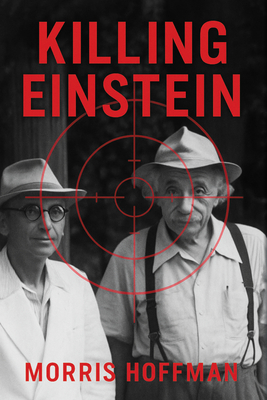
A dimwitted FBI agent tries to save Albert Einstein and Kurt G???del from a deranged Nazi academic, double agents, and an elite assassination team sent by Heinrich Himmler. Understanding G???del's famous incompleteness theorem becomes the key, but will the dull G-man be up to it?
Read More
A dimwitted FBI agent tries to save Albert Einstein and Kurt G???del from a deranged Nazi academic, double agents, and an elite assassination team sent by Heinrich Himmler. Understanding G???del's famous incompleteness theorem becomes the key, but will the dull G-man be up to it?
Read Less
Add this copy of Killing Einstein to cart. $20.31, like new condition, Sold by GreatBookPricesUK5 rated 5.0 out of 5 stars, ships from Castle Donington, DERBYSHIRE, UNITED KINGDOM, published 2026 by Resource Publications (CA).
Choose your shipping method in Checkout. Costs may vary based on destination.
Seller's Description:
Fine. Trade paperback (US). Glued binding. 218 p. In Stock. 100% Money Back Guarantee. Brand New, Perfect Condition, allow 4-14 business days for standard shipping. To Alaska, Hawaii, U.S. protectorate, P.O. box, and APO/FPO addresses allow 4-28 business days for Standard shipping. No expedited shipping. All orders placed with expedited shipping will be cancelled. Over 3, 000, 000 happy customers.
Add this copy of Killing Einstein to cart. $20.59, new condition, Sold by GreatBookPricesUK5 rated 5.0 out of 5 stars, ships from Castle Donington, DERBYSHIRE, UNITED KINGDOM, published 2026 by Resource Publications (CA).
Choose your shipping method in Checkout. Costs may vary based on destination.
Seller's Description:
New. Trade paperback (US). Glued binding. 218 p. In Stock. 100% Money Back Guarantee. Brand New, Perfect Condition, allow 4-14 business days for standard shipping. To Alaska, Hawaii, U.S. protectorate, P.O. box, and APO/FPO addresses allow 4-28 business days for Standard shipping. No expedited shipping. All orders placed with expedited shipping will be cancelled. Over 3, 000, 000 happy customers.
Add this copy of Killing Einstein to cart. $24.57, new condition, Sold by Ingram Customer Returns Center rated 5.0 out of 5 stars, ships from NV, USA, published 2026 by Resource Publications (CA).
Add this copy of Killing Einstein to cart. $35.18, new condition, Sold by Ingram Customer Returns Center rated 5.0 out of 5 stars, ships from NV, USA, published 2026 by Resource Publications (CA).
Add this copy of Killing Einstein to cart. $43.07, new condition, Sold by Paperbackshop rated 5.0 out of 5 stars, ships from Bensenville, IL, UNITED STATES, published 2026 by Resource Publications (CA).
Add this copy of Killing Einstein to cart. $26.18, like new condition, Sold by GreatBookPrices rated 4.0 out of 5 stars, ships from Columbia, MD, UNITED STATES, published 2026 by Resource Publications (CA).
Choose your shipping method in Checkout. Costs may vary based on destination.
Seller's Description:
Fine. Trade paperback (US). Glued binding. 218 p. In Stock. 100% Money Back Guarantee. Brand New, Perfect Condition, allow 4-14 business days for standard shipping. To Alaska, Hawaii, U.S. protectorate, P.O. box, and APO/FPO addresses allow 4-28 business days for Standard shipping. No expedited shipping. All orders placed with expedited shipping will be cancelled. Over 3, 000, 000 happy customers.
Add this copy of Killing Einstein to cart. $26.37, new condition, Sold by GreatBookPrices rated 4.0 out of 5 stars, ships from Columbia, MD, UNITED STATES, published 2026 by Resource Publications (CA).
Choose your shipping method in Checkout. Costs may vary based on destination.
Seller's Description:
New. Trade paperback (US). Glued binding. 218 p. In Stock. 100% Money Back Guarantee. Brand New, Perfect Condition, allow 4-14 business days for standard shipping. To Alaska, Hawaii, U.S. protectorate, P.O. box, and APO/FPO addresses allow 4-28 business days for Standard shipping. No expedited shipping. All orders placed with expedited shipping will be cancelled. Over 3, 000, 000 happy customers.
Killing Einstein is a historical thriller with a wonderfully eccentric brainpan. Author Morris Hoffman imagines a wartime FBI surveillance operation around Albert Einstein and Kurt G�¶del, then yokes it to espionage, philosophical argument, and an assassination plot. The story is told by Charlie Richards, a Bureau man whose first task is to trail the two thinkers through Princeton and eavesdrop on their walks, only to find himself drawn into their friendship, their ideas, and finally a lethal tangle of divided loyalties. It is, improbably, a novel about spies, logic, friendship, betrayal, and the terrifying gap between truth and proof, and it makes that odd compound feel deliberate rather than gimmicky.
Charlie is funny without being cute, self-deprecating without becoming shapeless, and just vain enough to feel human. Hoffman gives him a conversational intelligence that can pivot from deadpan Bureau satire to genuine wonder, and that tonal agility keeps the book buoyant even when it wanders into difficult intellectual country. The Einstein-G�¶del scenes are the live wire here: Einstein comes off as playful, porous, almost meteorological in his energy, while G�¶del is all fretful rigor and haunted exactitude. Their friendship has real charge. I didnâ��t feel that I was being handed two monuments in overcoats; I felt I was trailing two singular men whose minds alter the weather around them.
I was also surprised by how confidently the novel lets abstract thought matter. Many books flirt with big ideas and then retreat to plot when things get difficult. This one keeps its nerve. It asks me to care not only whether Einstein survives, but whether Charlie can understand what G�¶del is trying to show him about incompleteness, and whether such understanding can actually change a life. That ambition gives the novel its splendor. The exposition is generous. Readers allergic to mathematical or philosophical detours may feel the gears showing. But I would rather read a book that risks density than one that trims its own mind to look more streamlined. Killing Einstein is thoughtful and contains more than a standard thriller usually dares.
I�d hand this to readers of historical thrillers, espionage fiction, alternate-history-adjacent suspense, and anyone who likes novels where ideas have teeth. Fans of Philip Kerr or Umberto Eco would probably find familiar pleasures here, though Hoffman is less noir than Kerr and less baroque than Eco; the closest comparison might be a wartime spy novel written by someone who genuinely enjoys the metaphysics. This is a book for readers who don�t mind being asked to think while the window glass is breaking. Killing Einstein is a thriller that makes the mind feel like a battlefield.
Sheri (Reader Views)
Apr 11, 2026
Surveillance and Truth in Killing Einstein
Morris Hoffmanâ��s Killing Einstein is a historical espionage novel with a dryly comic intellectual and philosophical core. At its heart is protagonist and narrator Charlie Richards, a former FBI agent who recalls a period during which he surveilled and protected both Albert Einstein and Kurt G�¶del. As the intrigue develops, we begin to see that the novel, in a very sophisticated way, transforms surveillance itself into a sort of philosophical inquiry.
The novel opens during an actual assassination attempt in Princeton, highlighting the fact that Einsteinâ��s life is in danger. The assassination team is later identified as Nazi, and Charlie is originally brought in to surveil Einstein and famed mathematician Kurt G�¶del. They suspect Einstein and G�¶del are up to something:
My control, who told me the Bureau had restarted security surveillance on Einstein right after Pearl Harbor, also told me that at the beginning G�¶del would just walk to Einsteinâ��s house, and then theyâ��d stroll down through the small graduate campus and through Springdale Golf Course to Fuld Hall. But it appeared they soon tired of this same walk, so they began to meet at different locations and to take different routes. This in fact was something that had gotten up DBSâ��s snout.
Actually, nothing nefarious is taking place between the two scientific giants, and in fact, Charlie is discovered by the pair and develops a friendly relationship with the two men. Einstein takes the time to really explain GÃ?¶delââ?¬â?¢s concept of incompleteness, which has a profound impact on Charlie, who remarks that ââ?¬Å"ââ?¬Â¦the most pristine of all truthsââ?¬"mathematical onesââ?¬"are larger than their proofs. That proof can never fully capture truth.ââ?¬Â?
Quite a reflection for someone working as a spy.
Charlie becomes very attached to the two older scientists, and in fact, at one point, he even starts arranging his reports to ensure that neither Albert nor Kurt ever becomes a real suspect, highlighting Einstein�s rant against Stalin and the Nazis:
This giant happiness machine is now turned to the goal of ending this war. Its massive capacity will do just that. It is only a matter of time. And when it shatters Nazism, perhaps it can shatter communism along with it.
Unfortunately, that assassination attempt does materialize. This time, Charlie is able to save both Einstein and G�¶del. However, we also learn some rather unsettling news about Charlieâ��s allegiances, which puts the ending of the novel in question and really ramps up the stakes.
As suggested earlier, what I really loved was Charlie�s transformation from an FBI spook into a navel-gazing philosopher asking the big questions in the deep end of the pool. He is learning what it means to be a cog in a bigger structure, and he is learning to demand clarity in his search for the truth. Here we have the man assigned to get to the bottom of things, and he is hiding the biggest secret: he is both watcher and watched, the loyal friend and the traitor, inside and outside the system at once.
Iâ��ll leave Charlieâ��s final secret for the reader to uncover, but itâ��s clear that he has become emblematic of G�¶delâ��s paradox: a figure who cannot be fully explained within the system that produced him. In any case, Killing Einstein by Morris Hoffman manages to be more than just a spy novel. It rather takes us deep into philosophical and ontological territory, asking just the kinds of questions that Einstein and G�¶del would want us to ask ourselves.