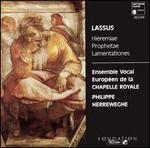
Lassus made this setting of the Lamentations of the Prophet Jeremiah for the monastery of Benediktbeuren in 1585. In its composition, he adhered to the directive of the Council of Trent that polyphony be simplified so that the meaning of the text would not be lost in a sea of contrapuntal complexity. Lassus also retreated from the more adventurous harmonic language of his youth, and the result is a work of clarity and directness in which the words are clearly comprehensible. The nine motets that make up the piece were ...
Read More
Lassus made this setting of the Lamentations of the Prophet Jeremiah for the monastery of Benediktbeuren in 1585. In its composition, he adhered to the directive of the Council of Trent that polyphony be simplified so that the meaning of the text would not be lost in a sea of contrapuntal complexity. Lassus also retreated from the more adventurous harmonic language of his youth, and the result is a work of clarity and directness in which the words are clearly comprehensible. The nine motets that make up the piece were written to be sung on Maundy Thursday, Good Friday, and Holy Saturday of Holy Week. They are consistently subdued and solemn in tone, intended for quiet meditation. Within these restraints, Lassus created a set of works of purity, serenity, and gentle loveliness. Because of the monastic setting, the Lamentations would originally have been sung by an all-male chorus, but conductor Philippe Herreweghe uses the mixed chorus Ensemble Vocal Européen. The choice may not satisfy sticklers for...
Read Less
Add this copy of Lamentations of Jeremiah to cart. $17.31, good condition, Sold by Wonder Book - Member ABAA/ILAB rated 5.0 out of 5 stars, ships from Frederick, MD, UNITED STATES, published 1992 by Harmonia Mundi.