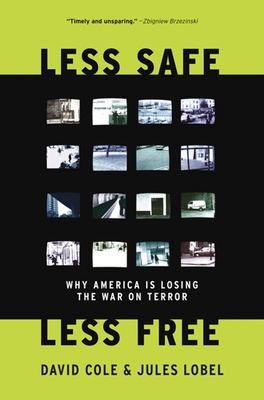
In this brilliantly conceived critique, two of the country's leading constitutional scholars argue that the Bush administration's preemptive approach to domestic and international security has not only compromised our character but has in fact made us more vulnerable to future terrorist attacks. In a groundbreaking analysis of efforts employed in the name of protecting its citizens--preventive detention, coercive interrogation, pretextual prosecutions, registration of Arab and Muslim men, and preventive war--law professors ... Read More
In this brilliantly conceived critique, two of the country's leading constitutional scholars argue that the Bush administration's preemptive approach to domestic and international security has not only compromised our character but has in fact made us more vulnerable to future terrorist attacks. In a groundbreaking analysis of efforts employed in the name of protecting its citizens--preventive detention, coercive interrogation, pretextual prosecutions, registration of Arab and Muslim men, and preventive war--law professors David Cole and Jules Lobel expose the government's abysmal record of failed prosecutions and empty successes. The authors argue that these results, when coupled with the resentment such coercive tactics have engendered throughout the world, have left us less safe than we would be had we employed a more sensible and less controversial preventive strategy. The book concludes by proposing an alternative preventive strategy to guide us into the future. Already standard reading for those who question the idea that "war" is the appropriate response to terrorism, Less Safe, Less Free offers an eloquent and original argument for a return to the rule of law. Read Less
Add this copy of Less Safe, Less Free: the Failure of Pre-Emption in the to cart. $14.85, very good condition, Sold by Halcyon Books rated 5.0 out of 5 stars, ships from LONDON, LONDON, UNITED KINGDOM, published 2007 by THE NEW PRESS.
Add this copy of Less Safe, Less Free: Why America is Losing the War on to cart. $19.00, very good condition, Sold by Paradise Found Books rated 5.0 out of 5 stars, ships from Chico, CA, UNITED STATES, published 2007 by The New Press.
Add this copy of Less Safe, Less Free: Why America is Losing the War on to cart. $20.98, very good condition, Sold by Wonder Book - Member ABAA/ILAB rated 5.0 out of 5 stars, ships from Frederick, MD, UNITED STATES, published 2007 by New Press.
Choose your shipping method in Checkout. Costs may vary based on destination.
Seller's Description:
Very Good. Very Good condition. Very Good dust jacket. A copy that may have a few cosmetic defects. May also contain light spine creasing or a few markings such as an owner's name, short gifter's inscription or light stamp.
Add this copy of Less Safe, Less Free: Why America is Losing the War on to cart. $26.96, very good condition, Sold by Wonder Book - Member ABAA/ILAB rated 5.0 out of 5 stars, ships from Frederick, MD, UNITED STATES, published 2007 by New Press.
Add this copy of Less Safe, Less Free: Why America is Losing the War on to cart. $105.50, new condition, Sold by GridFreed rated 5.0 out of 5 stars, ships from San Diego, CA, UNITED STATES, published 2009 by The New Press.
Add this copy of Less Safe, Less Free: Why America is Losing the War on to cart. $105.50, new condition, Sold by GridFreed rated 5.0 out of 5 stars, ships from San Diego, CA, UNITED STATES, published 2007 by New Press, The.
Add this copy of Less Safe, Less Free; Why America is Losing the War on to cart. $107.00, good condition, Sold by Ground Zero Books, Ltd. rated 5.0 out of 5 stars, ships from Silver Spring, MD, UNITED STATES, published 2007 by The New Press.
Choose your shipping method in Checkout. Costs may vary based on destination.
Seller's Description:
Rhoda Baer (Author Cole photograph) and Robert Dal. Good in Very good jacket. The format is approximately 5.75 inches by 8.5 inches. x, 326 pages. Notes. Index. Inscribed by the primary author on the half-title page. The inscription reads 9.25.07 For Tom Timm--Thanks for your support of the role of law. David Cole. Corners of many pages creased but not marks to text noted. David D. Cole is the National Legal Director of the American Civil Liberties Union (ACLU). Before joining the ACLU in July 2016, Cole was the Hon. George J. Mitchell Professor in Law and Public Policy at the Georgetown University Law Center from March 2014 through December 2016. He has published in various legal fields including constitutional law, national security, criminal justice, civil rights, and law and literature. Cole has litigated several significant First Amendment cases in the Supreme Court of the United States, as well a number of influential cases concerning civil rights and national security. He is also a legal correspondent to several mainstream media outlets and publications. Professor Jules Lobel is the Bessie McKee Walthour Endowed Chair at the University of Pittsburgh School of Law. Lobel co-authored the award winning book, Less Safe, Less Free: Why America is Losing the War on Terror (2007) with Professor David Cole, which won the first Roy C. Palmer Civil Liberties Prize for exemplary scholarship exploring the tension between civil liberties and national security. He is also the author of, Success without Victory: Lost Legal Battles and the Long Road to Justice in America (2003), and editor of several books on Civil Rights Litigation as well as the U.S. Constitution. A cogent critique of the new "preventive paradigm" in counterterrorism policy by two of the nation's leading legal scholars. "If we wait for threats to fully materialize, we will have waited too long."--President George W. Bush, defending the National Security Strategy doctrine "preemptive war, " Commencement Speech at West Point, June 1, 2002. In Steven Spielberg's science fiction thriller Minority Report, the Justice Department uses psychic visionaries to predict and prevent future crimes. President Bush has no psychic visionaries, but in fighting the war on terrorism his administration has nonetheless adopted a sweeping new "preemptive" strategy, which turns on the ability to predict the future. At home and abroad, the administration has cut corners on fundamental commitments of the rule of law in the name of preventing future attacks--from "waterboarding" detainees, to disappearing suspects into secret CIA prisons, to attacking Iraq against the wishes of the UN Security Council and most of the world when it posed no imminent threat of attacking us. In this brilliantly conceived critique, two of the country's preeminent constitutional scholars argue that the great irony is that these sacrifices in the rule of law, adopted in the name of prevention, have in fact made us more susceptible to future terrorist attacks. They conclusively debunk the administration's claim that it is winning the war on terror and offer an alternative strategy in which the rule of law is an asset, not an obstacle, in the struggle to keep us both safe and free. Derived from a Kirkus review: Call it speculation on disaster, the administration's policy of guessing where future threats lie and then impinging, imprisoning, invading. That policy, argue Cole and Lobel, is a failure. "There is nothing wrong with prevention as an objective, " the authors assert; prevention is a goal of public safety as much as of public health. Yet the administration's "preventive paradigm" attacks the rule of law writ large, and specifically commitments to equality, transparency, due process, checks and balances, basic human rights and other operational principles and ideals. "Bush's preventive paradigm, " Cole and Lobel maintain, "has violated each of these commitments, imposing double standards on the most vulnerable, operating in secret, denying fair trials, imposing...