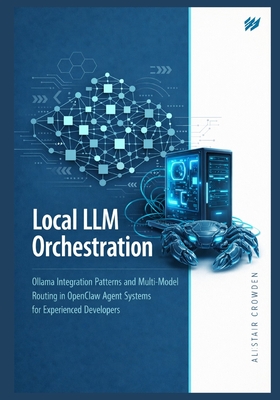
Local LLM Orchestration: Ollama Integration Patterns and Multi-Model Routing in OpenClaw Agent Systems for Experienced Developers
Write The First Customer Review
This volume examines the technical implementation of local large language model orchestration within the OpenClaw framework, focusing on integration with Ollama for on-device inference and hybrid routing that incorporates GPT-series and Claude API endpoints. It details configuration approaches, prompt routing logic, context management across heterogeneous models, performance characteristics of quantized local models, and architectural patterns for combining cloud reasoning with local execution in autonomous agent workflows. ...
Read More
This volume examines the technical implementation of local large language model orchestration within the OpenClaw framework, focusing on integration with Ollama for on-device inference and hybrid routing that incorporates GPT-series and Claude API endpoints. It details configuration approaches, prompt routing logic, context management across heterogeneous models, performance characteristics of quantized local models, and architectural patterns for combining cloud reasoning with local execution in autonomous agent workflows. Key topics include provider configuration in OpenClaw's JSON schema, model failover and load balancing mechanisms, tool execution in mixed-inference environments, memory persistence strategies compatible with Ollama endpoints, and optimization techniques for latency-sensitive operations on consumer-grade hardware. The discussion emphasizes practical considerations for production-grade deployments, such as security boundaries between local and remote inference, error handling in multi-provider setups, and extension of agent capabilities through Ollama-hosted specialized models. Intended for software developers, AI systems engineers, and infrastructure specialists with existing experience in agent frameworks, LLM APIs, container orchestration, and local inference tooling. Familiarity with OpenAI-compatible endpoints, YAML/JSON configuration, and Python-based tooling is assumed. Incorporate this technical reference into your workflow to implement robust, privacy-preserving agent orchestration in 2026 environments.
Read Less