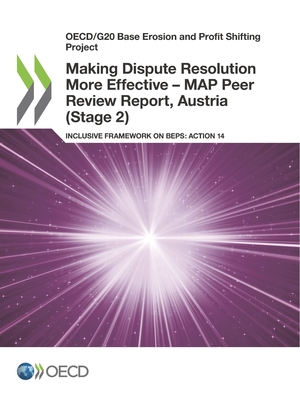
Addressing base erosion and profit shifting (BEPS) is a key priority of governments around the globe. In 2013, OECD and G20 countries, working together on an equal footing, adopted a 15-point Action Plan to address BEPS. Beyond securing revenues by realigning taxation with economic activities and value creation, the OECD/G20 BEPS Project aims to create a single set of consensus-based international tax rules to address BEPS, and hence to protect tax bases while offering increased certainty and predictability to taxpayers. In ... Read More
Addressing base erosion and profit shifting (BEPS) is a key priority of governments around the globe. In 2013, OECD and G20 countries, working together on an equal footing, adopted a 15-point Action Plan to address BEPS. Beyond securing revenues by realigning taxation with economic activities and value creation, the OECD/G20 BEPS Project aims to create a single set of consensus-based international tax rules to address BEPS, and hence to protect tax bases while offering increased certainty and predictability to taxpayers. In 2016, the OECD and G20 established an Inclusive Framework on BEPS to allow interested countries and jurisdictions to work with OECD and G20 members to develop standards on BEPS related issues and reviewing and monitoring the implementation of the whole BEPS Package. Over 100 countries and jurisdictions have joined the Inclusive Framework. Under Action 14, jurisdictions have committed to implement a minimum standard to strengthen the effectiveness and efficiency of the mutual agreement procedure (MAP). The MAP is included in Article 25 of the OECD Model Tax Convention and commits countries to endeavour to resolve disputes related to the interpretation and application of tax treaties. The Action 14 Minimum Standard has been translated into specific terms of reference and a methodology for the peer review and monitoring process. The minimum standard is complemented by a set of best practices. The peer review process is conducted in two stages. Stage 1 assesses jurisdictions against the terms of reference of the minimum standard according to an agreed schedule of review. Stage 2 focuses on monitoring the follow-up of any recommendations resulting from jurisdictions' stage 1 peer review report. This report reflects the outcome of the stage 1 peer review of the implementation of the Action 14 Minimum Standard by Austria, which is accompanied by a document addressing the implementation of best practices. Read Less
Add this copy of Making Dispute Resolution More Effective to cart. $35.12, new condition, Sold by Books2anywhere rated 5.0 out of 5 stars, ships from Fairford, GLOUCESTERSHIRE, UNITED KINGDOM, published 2020 by Organization for Economic Co-operation and Development (OECD).
Publisher:
Org. for Economic Cooperation & Development
Published:
4/9/2020 12: 00: 00 AM
Language:
English
Alibris ID:
18987985031
Shipping Options:
Standard Shipping: $4.88
Choose your shipping method in Checkout. Costs may vary based on destination.
Seller's Description:
PLEASE NOTE, WE DO NOT SHIP TO DENMARK. New Book. Shipped from UK in 4 to 14 days. Established seller since 2000. Please note we cannot offer an expedited shipping service from the UK.
Add this copy of Making Dispute Resolution More Effective - MAP Peer to cart. $39.06, new condition, Sold by Ingram Customer Returns Center rated 5.0 out of 5 stars, ships from NV, USA, published 2020 by Org. for Economic Cooperation & Development.