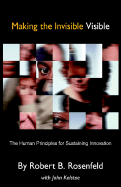
What is innovation? Popular culture thinks it knows. An innovation is "the better mousetrap." It is the complex widget that makes a toaster run better, a computer work faster, the men and women in a spacecraft breathe easier. What is an innovator, the maker of the widget? The figure that lurks behind the better mousetrap is often thought of as wild-eyed and misunderstood, tirelessly working away in a dark basement or long-forgotten barn. These popular conceptions have some truth in them, but they are severely limited. ...
Read More
What is innovation? Popular culture thinks it knows. An innovation is "the better mousetrap." It is the complex widget that makes a toaster run better, a computer work faster, the men and women in a spacecraft breathe easier. What is an innovator, the maker of the widget? The figure that lurks behind the better mousetrap is often thought of as wild-eyed and misunderstood, tirelessly working away in a dark basement or long-forgotten barn. These popular conceptions have some truth in them, but they are severely limited. Innovation is more than high-tech gadgets, and innovators are complex, whole human beings of all different backgrounds and types. I propose this: An innovation is a creative act or solution that results in a quantifiable gain. An innovation is set into motion in the world of ideas, but is realized in the world of human action. Organizations need innovation like plants need water; without it, they die. One hundred and fifty years ago, the whole planet sat in candle-lit darkness at night. A century ago, the first scratchy sounds of radio echoed in the silence of the ether, forever linking large populations together. Fifty years ago, the surface of the moon was still the object of poetry, not yet of scientific exploration. Ten years ago, the world barely knew the Internet that today links my office in Rochester, New York, to a Zambian village. We live in a world of technological change, where newness clamors as it speeds by. This ephemeral aspect of life is critical to our survival and to our realization as a human race. At the same time, our economy is inextricably bound to this process. Businesses react to and generate change, at ever-increasing rates. But as important asthe dynamic of newness and invention is, it would be a mistake to think that all the methods of business are subject to the same law of change. In my 25 years of experience in and around the business of ideas, I've realized that there are constants that come in the form of operational principles-principles that relate to the relationship between people and ideas. Technologies change. People change. The paradox is that without applying timeless principles, the culture of change cannot endure. It is because of the timeless nature of the principles in my book that I deliberately omitted references to contemporary journals and resources. Instead, I've drawn examples from a wide variety of sources-from both inside and outside the business world, and from both current news and historic records. As you will see, these examples solidify the universality and timelessness of the innovation principles discussed throughout the book. Another important point to make is that sustaining innovation depends on the human beings who make it happen. I have found that to foster and sustain the creative spirit, an organization must understand and act in accordance with the human principles that underlie the innovation process. Understanding these principles requires an honest focus on people and their relationship with business and organizational concerns. Whether you work in the corporate world, a governmental or municipal agency, an academic institution, or the not-for-profit sector, these same principles still apply. This is because only human beings create ideas; only human beings can sow the seeds of innovation. In this book, it is my hope to show how focusing on people-their unique qualities, theirvalues, and their diverse organizational roles-is the most essential step in creating a vibrant, flourishing, innovating organization. While it is true, then, that business and technology play a critical role in the innovation process, the human element is the driving force. It can be said that the "right people" in an organization are its greatest asset; the wrong people are its greatest liability. Studies have shown, in fact, that the quality of a work force may, over time, be more important to a company's stock offering than its technology (see Figure 0.1). Figur
Read Less
Add this copy of Making the Invisible Visible: the Human Principles for to cart. $9.19, good condition, Sold by Goodwill Books rated 5.0 out of 5 stars, ships from Hillsboro, OR, UNITED STATES, published 2006 by Xlibris.
Add this copy of Making the Invisible Visible to cart. $15.95, very good condition, Sold by Delight of Life Books rated 5.0 out of 5 stars, ships from CEDAR, MI, UNITED STATES, published 2006 by Xlibris Corporation.
Add this copy of Making the Invisible Visible: the Human Principles for to cart. $119.68, new condition, Sold by GridFreed rated 5.0 out of 5 stars, ships from San Diego, CA, UNITED STATES, published 2006 by Xlibris.
Add this copy of Making the Invisible Visible: the Human Principles for to cart. $9.30, good condition, Sold by Greenworld Books rated 4.0 out of 5 stars, ships from Arlington, TX, UNITED STATES, published 2006 by Xlibris.
Choose your shipping method in Checkout. Costs may vary based on destination.
Seller's Description:
Good condition. It may show normal signs of use such as light writing highlighting or library markings but all pages are intact and the book is fully readable. A solid complete copy that's ready to enjoy.
Add this copy of Making the Invisible Visible: the Human Principles for to cart. $10.17, fair condition, Sold by ThriftBooks-Baltimore rated 4.0 out of 5 stars, ships from Halethorpe, MD, UNITED STATES, published 2006 by Xlibris.
Add this copy of Making the Invisible Visible: the Human Principles for to cart. $12.24, fair condition, Sold by BooksRun rated 4.0 out of 5 stars, ships from Philadelphia, PA, UNITED STATES, published 2006 by Xlibris.
Choose your shipping method in Checkout. Costs may vary based on destination.
Seller's Description:
Fair. The item might be beaten up but readable. May contain markings or highlighting, as well as stains, bent corners, or any other major defect, but the text is not obscured in any way.
Add this copy of Making the Invisible Visible: the Human Principles for to cart. $12.57, very good condition, Sold by HPB-Ruby rated 4.0 out of 5 stars, ships from Dallas, TX, UNITED STATES, published 2006 by Xlibris.
Choose your shipping method in Checkout. Costs may vary based on destination.
Seller's Description:
Very good. Connecting readers with great books since 1972! Used books may not include companion materials, and may have some shelf wear or limited writing. We ship orders daily and Customer Service is our top priority!
Add this copy of Making the Invisible Visible: the Human Principles for to cart. $39.69, good condition, Sold by Bonita rated 4.0 out of 5 stars, ships from Santa Clarita, CA, UNITED STATES, published 2006 by Xlibris.
Add this copy of Making the Invisible Visible: the Human Principles for to cart. $68.16, new condition, Sold by Just one more Chapter rated 4.0 out of 5 stars, ships from Miramar, FL, UNITED STATES, published 2006 by Xlibris.