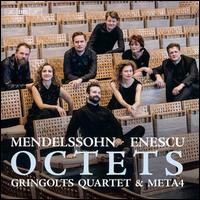
Mendelssohn, Enescu: Octets (2020)
The 19th century repertory for string octet is not large and is dominated by the Mendelssohn Octet in E flat major, Op. 20, heard here. Works by Niels Gade and Max Bruch are combined with it more often than the Octet for strings in C major, Op. 7, of George Enescu heard here, but the Enescu has much to recommend it. Both he and Mendelssohn were teenagers when they wrote their gloriously ambitious but somewhat overelaborate octets, both works are orchestral in nature, rather than being antiphonally conceived for a pair of ...
Read More
The 19th century repertory for string octet is not large and is dominated by the Mendelssohn Octet in E flat major, Op. 20, heard here. Works by Niels Gade and Max Bruch are combined with it more often than the Octet for strings in C major, Op. 7, of George Enescu heard here, but the Enescu has much to recommend it. Both he and Mendelssohn were teenagers when they wrote their gloriously ambitious but somewhat overelaborate octets, both works are orchestral in nature, rather than being antiphonally conceived for a pair of string quartets, and both seem to point backward -- Mendelssohn to Mozart and Enescu to late Romanticism -- and also forward to what was coming next. They differ as well: Mendelssohn's conception is melodic, favoring a first violin line, while the Enescu is a primarily contrapuntal work with a novel structure that, like the Symphony No. 7 in C major, Op. 105, telescopes the four movements of a conventional chamber music structure into a single movement marked more or less by sonata...
Read Less