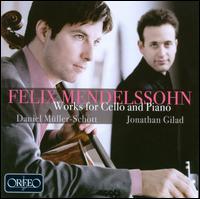
Among Mendelssohn's considerable chamber music output, the works for cello and piano had a special place for the composer. Although he was not himself a cellist, his brother Paul was an accomplished amateur and Mendelssohn likely kept him in mind when composing the three larger-scale works. Following in the footsteps of Beethoven, Mendelssohn continued to move more toward an equal partnership between the two instruments. By the time he composed the D major Sonata in 1843, a true feeling of cello sonata as opposed to a ...
Read More
Among Mendelssohn's considerable chamber music output, the works for cello and piano had a special place for the composer. Although he was not himself a cellist, his brother Paul was an accomplished amateur and Mendelssohn likely kept him in mind when composing the three larger-scale works. Following in the footsteps of Beethoven, Mendelssohn continued to move more toward an equal partnership between the two instruments. By the time he composed the D major Sonata in 1843, a true feeling of cello sonata as opposed to a sonata for piano and cello was achieved. This Orfeo album features cellist Daniel Müller-Schott and pianist Jonathan Gilad. Throughout the disc, Müller-Schott's lean, focused, powerful tone ensures that the cello is indeed the dominant instrument. While this type of penetrating, intense tone may not work well for other composers, it offers Mendelssohn's works a vivid clarity that others miss. Müller-Schott's interpretation highlights Mendelssohn's mercurial, vivacious side while still...
Read Less