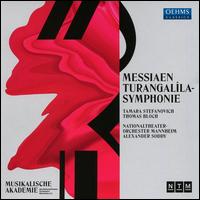
Messiaen: Turangalîla-Symphonie (2020)
Olivier Messiaen's Turangalîla-Symphonie is a work of many layers: of meaning, of texture, of tonality, of form. Its name was a coinage by Messiaen himself, made up of two Sanskrit words: lîla , meaning play or love, and turanga , meaning time or rhythm of time. The work is scored for a huge orchestra, among whose parts are interwoven a piano -- here played by the very crisp Tamara Stefanovich -- and the ondes martenot, the pioneering electronic instrument. The tonality ranges from atonal with proto-total serial ... Read More
Olivier Messiaen's Turangalîla-Symphonie is a work of many layers: of meaning, of texture, of tonality, of form. Its name was a coinage by Messiaen himself, made up of two Sanskrit words: lîla , meaning play or love, and turanga , meaning time or rhythm of time. The work is scored for a huge orchestra, among whose parts are interwoven a piano -- here played by the very crisp Tamara Stefanovich -- and the ondes martenot, the pioneering electronic instrument. The tonality ranges from atonal with proto-total serial procedures to almost purely tonal, and the form contains cyclical elements. In short, this is a dense work with a great deal going on. Yet it lives up to Messiaen's description of the music as "love song, hymn to joy, time, movement, rhythm, life and death." The fourth-movement "Chant d'amour 2" is one of the few sections of a 20th century masterpiece that one might actually put on the player in a romantic situation. The Turangalîla-Symphonie was premiered in Boston by Leonard... Read Less