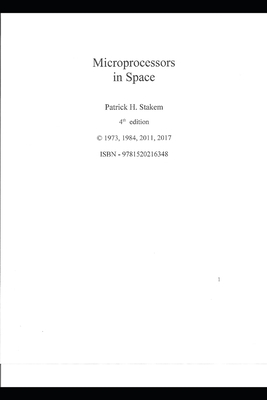
This book discusses .the use of microprocessors in space missions, from the earliest 4-bit machines to the most current 64-bit implementations. It covers the transition from monolithic processors with extensive glue logic, to IP cores instantiated in FPGA's. It gives the high-lights of the microprocessors sent and being sent into space, and the problems of sustaining their operations there. Microprocessors orbit the earth, sit on other planets, and have left the Solar system into interstellar space. They are the key ...
Read More
This book discusses .the use of microprocessors in space missions, from the earliest 4-bit machines to the most current 64-bit implementations. It covers the transition from monolithic processors with extensive glue logic, to IP cores instantiated in FPGA's. It gives the high-lights of the microprocessors sent and being sent into space, and the problems of sustaining their operations there. Microprocessors orbit the earth, sit on other planets, and have left the Solar system into interstellar space. They are the key components for spacecraft autonomy, and for collecting, storing, and returning the volumes of information that we receive from off-planet sources. Spacecraft microprocessors are a special subset of embedded computers. Most spacecraft include 10's ro 100's of processors, doing tasks such as attitude and orbit control, power monitoring and control, telemetry formatting and command handling, data storage management, and instrument control. Without these microprocessors, the amount that we know about our neighboring planets and the intervening space would be vastly limited. Early flight computers were custom designs, but cost and performance issues have driven the development of variants of commercial chips. Aerospace applications are usually classic embedded applications. Space applications are rather limited in number, and, until recently, almost exclusively meant NASA, ESA, or some other government agency. Flight systems electronics usually require MIL-STD-883b, Class-S, radiation-hard (total dose), SEU-tolerant parts. Specific issues of radiation tolerance are disucssed. Class-S parts are specifically for space-flight use. Because of the need for qualifying the parts for space, the state-of-the-art in spaceborne electronics usually lags that of the terrestrial commercial parts by 5 years. The new Cubesat concept bring the idea of a personal satellite within the reach of University Programs, and even for some individuals.Processors used in aerospace applications, as any semiconductor-based electronics, need to meet stringent selection, screening, packaging and testing requirements, and characterizations because of the unique environment. Most aerospace electronics, and the whole understanding of radiation effects, were driven by the cold war defense buildup from the 1960's through the 1980's. This era was characterized by the function-at-any-cost, melt-before-fail design philosophy. In the 1990, the byword was COTS -- use of Commercial, Off-The-Shelf products. Thus, instead of custom, proprietary processor architecture's, we are now seeing the production of specialized products derived from commercial lines. In the era of decreasing markets, the cost of entry, and of maintaining presence in this tiny market niche, are prohibitively high for many companies.
Read Less
Add this copy of Microprocessors in Space to cart. $17.04, new condition, Sold by Ingram Customer Returns Center rated 5.0 out of 5 stars, ships from NV, USA, published 2017 by Independently Published.
Add this copy of Microprocessors in Space to cart. $16.63, like new condition, Sold by GreatBookPrices rated 4.0 out of 5 stars, ships from Columbia, MD, UNITED STATES, published 2017 by Independently Published.
Choose your shipping method in Checkout. Costs may vary based on destination.
Seller's Description:
Fine. Trade paperback (US). Glued binding. 116 p. Space, 4. In Stock. 100% Money Back Guarantee. Brand New, Perfect Condition, allow 4-14 business days for standard shipping. To Alaska, Hawaii, U.S. protectorate, P.O. box, and APO/FPO addresses allow 4-28 business days for Standard shipping. No expedited shipping. All orders placed with expedited shipping will be cancelled. Over 3, 000, 000 happy customers.
Add this copy of Microprocessors in Space to cart. $16.73, new condition, Sold by GreatBookPrices rated 4.0 out of 5 stars, ships from Columbia, MD, UNITED STATES, published 2017 by Independently Published.
Choose your shipping method in Checkout. Costs may vary based on destination.
Seller's Description:
New. Trade paperback (US). Glued binding. 116 p. Space, 4. In Stock. 100% Money Back Guarantee. Brand New, Perfect Condition, allow 4-14 business days for standard shipping. To Alaska, Hawaii, U.S. protectorate, P.O. box, and APO/FPO addresses allow 4-28 business days for Standard shipping. No expedited shipping. All orders placed with expedited shipping will be cancelled. Over 3, 000, 000 happy customers.