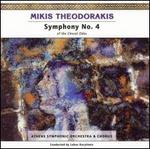
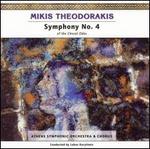
Mikis Theodorakis: Symphony No. 4 (1998)
Mikis Theodorakis' Symphony No. 4, "Of the Choral Odes" is a setting of the "Eumenides" by Aeschylus and "The Phoenician Women" by Euripides, joined together in a massive work that conveys classical Greek tragedy through the form of a modern choral symphony. In his liner notes, Theodorakis suggests that, because the term symphony is derived from Greek, it is best left to a Greek to define it; and he points out that his conception of a symphony is analogous to a wall painting. From this, it can be gathered that conventional ...
Read More
Mikis Theodorakis' Symphony No. 4, "Of the Choral Odes" is a setting of the "Eumenides" by Aeschylus and "The Phoenician Women" by Euripides, joined together in a massive work that conveys classical Greek tragedy through the form of a modern choral symphony. In his liner notes, Theodorakis suggests that, because the term symphony is derived from Greek, it is best left to a Greek to define it; and he points out that his conception of a symphony is analogous to a wall painting. From this, it can be gathered that conventional western sonata form is not a concern for him, and that this long, two-part work derives its tension and power from its ancient Greek texts, and follows its own logic rather than abstract rules. There's no denying the force and directness of Theodorakis' music, which has power in its dark scoring, austere counterpoint, massed unisons, and immense orchestral sonorities; the live 1987 performance by contralto Kiki Morphoniou, soprano Aleka Drakopoulou, cellist Dana Chatzigeorgiou, and...
Read Less