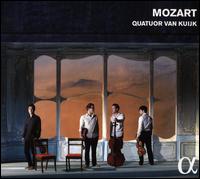
Shortly after he arrived in Vienna in 1782, Wolfgang Amadeus Mozart began composing his six "Haydn" Quartets, inspired by recent contact with his new friend, Franz Joseph Haydn. Not only had Haydn composed an important set of string quartets in 1781, which Mozart studied closely, he also played violin in a quartet with Mozart as violist. These influences led Mozart to compose his String Quartet No. 16 in E flat major, K. 428, and his String Quartet No. 19 in C major, K. 465, "Dissonant," which bookend the Divertimento in D ...
Read More
Shortly after he arrived in Vienna in 1782, Wolfgang Amadeus Mozart began composing his six "Haydn" Quartets, inspired by recent contact with his new friend, Franz Joseph Haydn. Not only had Haydn composed an important set of string quartets in 1781, which Mozart studied closely, he also played violin in a quartet with Mozart as violist. These influences led Mozart to compose his String Quartet No. 16 in E flat major, K. 428, and his String Quartet No. 19 in C major, K. 465, "Dissonant," which bookend the Divertimento in D major, K. 136, on this 2016 release from Alpha Classics. The Quatuor Van Kuijk, a French string quartet in spite of its Dutch name, deliver exciting and engaging performances of the string quartets, finding the right blend of flashiness and warmth that characterize Mozart's newfound maturity. Yet the youthful Divertimento is treated with comparable brilliance, if slightly less ardor, and all three works make a delightful program, showing important aspects of the development of the...
Read Less