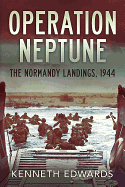
Add this copy of Operation Neptune to cart. $36.31, fair condition, Sold by Anybook rated 5.0 out of 5 stars, ships from Lincoln, UNITED KINGDOM, published 1946 by Collins.
Choose your shipping method in Checkout. Costs may vary based on destination.
Seller's Description:
This is an ex-library book and may have the usual library/used-book markings inside. This book has hardback covers. With owner's name inside cover. In fair condition, suitable as a study copy. Dust jacket in poor condition. Please note the Image in this listing is a stock photo and may not match the covers of the actual item, 650grams, ISBN:
Add this copy of Operation Neptune, to cart. $24.95, fair condition, Sold by Ed's Editions, LLC rated 5.0 out of 5 stars, ships from West Columbia, SC, UNITED STATES, published 1946 by Collins.
Choose your shipping method in Checkout. Costs may vary based on destination.
Seller's Description:
Fair in Acceptable jacket. Hardcover First UK edition with a dust jacket. Modest shelf wear to jacket and book. Both are Clean, has a good binding, no marks or notations. Prompt shipping.
Add this copy of Operation Neptune to cart. $35.50, very good condition, Sold by Kisselburg Military Books rated 5.0 out of 5 stars, ships from Potomac, MD, UNITED STATES, published 1946 by Collins.
Add this copy of Operation Neptune to cart. $52.00, good condition, Sold by Ground Zero Books, Ltd. rated 5.0 out of 5 stars, ships from Silver Spring, MD, UNITED STATES, published 1946 by Collins.
Choose your shipping method in Checkout. Costs may vary based on destination.
Seller's Description:
Good. No Dust Jacket present. Endpaper maps. 319, [1] pages. Illustrations (all listed are present). Cover has some wear and soiling. Corners somewhat bumped. Some spine fading. Commander Kenneth Edwards was a distinguished naval historian. As a young man he was awarded the DSC in April 1917 for 'Performing good service at the landing and at the evacuation of Helles. Set a fine example to his men whilst assisting at salvage operations on Monitor M.30 under fire from enemy's guns. ' He wrote numerous books of which his best-selling book was based on life in a Royal Navy submarine, We Dive at Dawn. From an oil-pipeline laid across the English Channel sea-bed to the huge concrete Mulberry Harbors towed across to France, Operation Neptune was a logistical exercise without precedence. Following the Normandy landings of June 1944, huge amounts of matériel needed to be transported to the fighting armies. Neptune was a complex undertaking of unheard of complexity. Its importance is usually overlooked. The Normandy landings were the landing operations and associated airborne operations on Tuesday, 6 June 1944 of the Allied invasion of Normandy in Operation Overlord during World War II. Codenamed Operation Neptune and often referred to as D-Day, it was the largest seaborne invasion in history. The operation began the liberation of France (and later western Europe) and laid the foundations of the Allied victory on the Western Front. Planning for the operation began in 1943. In the months leading up to the invasion, the Allies conducted a substantial military deception, codenamed Operation Bodyguard, to mislead the Germans as to the date and location of the main Allied landings. The weather on D-Day was far from ideal, and the operation had to be delayed 24 hours; a further postponement would have meant a delay of at least two weeks, as the invasion planners had requirements for the phase of the moon, the tides, and the time of day that meant only a few days each month were deemed suitable. Adolf Hitler placed Field Marshal Erwin Rommel in command of German forces and of developing fortifications along the Atlantic Wall in anticipation of an Allied invasion. U.S. President Franklin D. Roosevelt placed Major General Dwight D. Eisenhower in command of Allied forces. The amphibious landings were preceded by extensive aerial and naval bombardment and an airborne assault-the landing of 24, 000 American, British, and Canadian airborne troops shortly after midnight. Allied infantry and armored divisions began landing on the coast of France at 06: 30. The target 50-mile stretch of the Normandy coast was divided into five sectors: Utah, Omaha, Gold, Juno, and Sword. Strong winds blew the landing craft east of their intended positions, particularly at Utah and Omaha. The men landed under heavy fire from gun emplacements overlooking the beaches, and the shore was mined and covered with obstacles such as wooden stakes, metal tripods, and barbed wire, making the work of the beach-clearing teams difficult and dangerous. Casualties were heaviest at Omaha, with its high cliffs. At Gold, Juno, and Sword, several fortified towns were cleared in house-to-house fighting, and two major gun emplacements at Gold were disabled using specialized tanks. The Allies failed to achieve any of their goals on the first day. Carentan, Saint-Lô, and Bayeux remained in German hands, and Caen, a major objective, was not captured until 21 July. Only two of the beaches (Juno and Gold) were linked on the first day, and all five beachheads were not connected until 12 June; however, the operation gained a foothold that the Allies gradually expanded over the coming months. German casualties on D-Day have been estimated at 4, 000 to 9, 000 men. Allied casualties were documented for at least 10, 000, with 4, 414 confirmed dead. Museums, memorials, and war cemeteries in the area now host many visitors each year.
Add this copy of Operation Neptune, to cart. $23.48, fair condition, Sold by ThriftBooks-Dallas rated 4.0 out of 5 stars, ships from Dallas, TX, UNITED STATES, published by Collins.