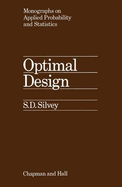
Prior to the 1970's a substantial literature had accumulated on the theory of optimal design, particularly of optimal linear regression design. To a certain extent the study of the subject had been piecemeal, different criteria of optimality having been studied separately. Also to a certain extent the topic was regarded as being largely of theoretical interest and as having little value for the practising statistician. However during this decade two significant developments occurred. It was observed that the various ...
Read More
Prior to the 1970's a substantial literature had accumulated on the theory of optimal design, particularly of optimal linear regression design. To a certain extent the study of the subject had been piecemeal, different criteria of optimality having been studied separately. Also to a certain extent the topic was regarded as being largely of theoretical interest and as having little value for the practising statistician. However during this decade two significant developments occurred. It was observed that the various different optimality criteria had several mathematical properties in common; and general algorithms for constructing optimal design measures were developed. From the first of these there emerged a general theory of remarkable simplicity and the second at least raised the possibility that the theory would have more practical value. With respect to the second point there does remain a limiting factor as far as designs that are optimal for parameter estimation are concerned, and this is that the theory assumes that the model be collected is known a priori. This of course underlying data to is seldom the case in practice and it often happens that designs which are optimal for parameter estimation allow no possibility of model validation. For this reason the theory of design for parameter estimation may well have to be combined with a theory of model validation before its practical potential is fully realized. Nevertheless discussion in this monograph is limited to the theory of design optimal for parameter estimation.
Read Less
Add this copy of Optimal Design: an Introduction to the Theory for to cart. $17.90, good condition, Sold by Anybook rated 5.0 out of 5 stars, ships from Lincoln, UNITED KINGDOM, published 1980 by Chapman And Hall.
Choose your shipping method in Checkout. Costs may vary based on destination.
Seller's Description:
This is an ex-library book and may have the usual library/used-book markings inside. This book has hardback covers. In good all round condition. No dust jacket. Please note the Image in this listing is a stock photo and may not match the covers of the actual item, 300grams, ISBN: 0412229102.
Add this copy of Optimal Design: an Introduction to the Theory for to cart. $18.16, good condition, Sold by Anybook rated 5.0 out of 5 stars, ships from Lincoln, UNITED KINGDOM, published 1980 by Chapman And Hall.
Choose your shipping method in Checkout. Costs may vary based on destination.
Seller's Description:
This is an ex-library book and may have the usual library/used-book markings inside. This book has hardback covers. In good all round condition. No dust jacket. Please note the Image in this listing is a stock photo and may not match the covers of the actual item, 300grams, ISBN: 0412229102.
Add this copy of Optimal Design: an Introduction to the Theory for to cart. $19.65, good condition, Sold by Midtown Scholar Bookstore rated 5.0 out of 5 stars, ships from Harrisburg, PA, UNITED STATES, published 1980 by Chapman and Hall.
Add this copy of Optimal Design: an Introduction to the Theory for to cart. $94.92, new condition, Sold by Just one more Chapter rated 4.0 out of 5 stars, ships from Miramar, FL, UNITED STATES, published 1980 by Springer.