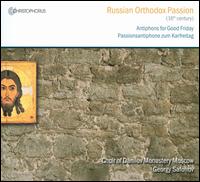
The notes to this release, translated from Russian but given only in German, French, and English, are not crystal clear for those not versed in Russian Orthodox music. Such details as where this music came from, whether it was orally transmitted, and what the relationship of the "tones" to Western (or Eastern) modes might be are only vaguely addressed. Nor does one learn much about the fine singers of the Moscow Danilov Monastery Choir and how they came to this music. The texts are given in Russian Cyrillic letters and in ...
Read More
The notes to this release, translated from Russian but given only in German, French, and English, are not crystal clear for those not versed in Russian Orthodox music. Such details as where this music came from, whether it was orally transmitted, and what the relationship of the "tones" to Western (or Eastern) modes might be are only vaguely addressed. Nor does one learn much about the fine singers of the Moscow Danilov Monastery Choir and how they came to this music. The texts are given in Russian Cyrillic letters and in translation, making it possible for the non-Russian listener to follow the general action but only intermittently the individual texts. What you do get from the notes and from listening is this, and it's plenty interesting: the chants, consisting of a set of antiphons for Good Friday and telling the Passion story, come from a manuscript of 1598 that, unlike other Russian manuscripts until much later, is written in "linear notation," which apparently is something like Western staff...
Read Less