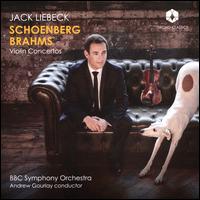
When Arnold Schoenberg emigrated to the U.S., he softened his style somewhat. However, this occurred in several stages. The Violin Concerto, Op. 36, is formally a neoclassic three-movement violin concerto, but it is a pure 12-tone work in which listeners have found it hard to gain a foothold, and it is not often played. CD buyers of this release by Jack Liebeck and the BBC Symphony Orchestra under Andrew Gourlay get an elegant note by the violinist explaining the personal significance he assigns to these works: his father, ...
Read More
When Arnold Schoenberg emigrated to the U.S., he softened his style somewhat. However, this occurred in several stages. The Violin Concerto, Op. 36, is formally a neoclassic three-movement violin concerto, but it is a pure 12-tone work in which listeners have found it hard to gain a foothold, and it is not often played. CD buyers of this release by Jack Liebeck and the BBC Symphony Orchestra under Andrew Gourlay get an elegant note by the violinist explaining the personal significance he assigns to these works: his father, partly of Jewish background, loved the Brahms concerto and, like Schoenberg, fled the Nazis. This doesn't necessarily fit with the whimsical whippet graphics (keep the dog away from that expensive violin!), but the result is a stately, deliberate Schoenberg concerto that seems to be trying to clarify the work's intricacies. Some of the intricacies are technical; Jascha Heifetz reputedly said the concerto would require a sixth finger ("I'll wait," was the composer's response). Liebeck...
Read Less