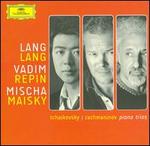
Ideally, a piano trio should be balanced in its voices and the parts more or less equally matched in expression, but it sometimes happens in late Romantic chamber music that an overwrought piano part can create the opposite conditions. In the Trio élégiaque No. 1 in G minor by Sergey Rachmaninov and the Piano Trio in A minor by Pyotr Il'yich Tchaikovsky, the piano is clearly the dominant force, because it carries most of the thematic material, harmonic textures, and dramatic gestures, and thereby reduces the violin and ... Read More
Ideally, a piano trio should be balanced in its voices and the parts more or less equally matched in expression, but it sometimes happens in late Romantic chamber music that an overwrought piano part can create the opposite conditions. In the Trio élégiaque No. 1 in G minor by Sergey Rachmaninov and the Piano Trio in A minor by Pyotr Il'yich Tchaikovsky, the piano is clearly the dominant force, because it carries most of the thematic material, harmonic textures, and dramatic gestures, and thereby reduces the violin and cello to subsidiary roles. As one of the great virtuoso pianists, Rachmaninov undoubtedly planned that the pianist should be the leader and conceived this single-movement trio almost as a piano sonata with obbligato parts for the strings, while Tchaikovsky simply overwrote the keyboard part, and its density and complexity make the violin and cello seem like weaker participants. With these problems in mind, pianist Lang Lang, violinist Vadim Repin, and cellist Mischa Maisky adjust their... Read Less
Add this copy of Tchaikovsky / Rachmaninov: Piano Trios to cart. $8.36, good condition, Sold by MERS Goodwill rated 5.0 out of 5 stars, ships from SAINT LOUIS, MO, UNITED STATES, published 2009 by Deutsche Grammophon.