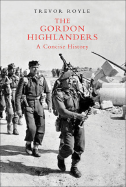
Add this copy of The Gordon Highlanders to cart. $30.77, good condition, Sold by Anybook rated 5.0 out of 5 stars, ships from Lincoln, UNITED KINGDOM, published 1968 by Hamish Hamilton.
Choose your shipping method in Checkout. Costs may vary based on destination.
Seller's Description:
This is an ex-library book and may have the usual library/used-book markings inside. This book has hardback covers. In good all round condition. No dust jacket. Please note the Image in this listing is a stock photo and may not match the covers of the actual item, 450grams, ISBN:
Add this copy of The Gordon Highlanders to cart. $17.00, very good condition, Sold by Weller Book Works, A.B.A.A. rated 5.0 out of 5 stars, ships from Salt Lake City, UT, UNITED STATES, published 1969 by Leo Cooper.
Add this copy of Gordon Highlanders to cart. $17.00, good condition, Sold by Book Bear rated 5.0 out of 5 stars, ships from West Brookfield, MA, UNITED STATES, published 1968 by Hamish Hamilton.
Choose your shipping method in Checkout. Costs may vary based on destination.
Seller's Description:
Good. Good Dust Jacket. 8vo-over 7¾"-9¾" tall. 133 pp. Tightly bound. Two corners lightly bumped. Text is free of markings. Owner's 1/4" x 1/2" name tag at top right corner front end paper. Light foxing to page edges. Good dust jacket. Jacket not price clipped. The primarily white dust jacket shows light soiling from age and use. This copy is smyth sewn. Smyth sewing is a method of bookbinding where groups of folded pages (referred to as signatures) are stitched together using binder thread. Each folded signature is sewn together individually with multiple stitches and then joined with other signatures to create the complete book block. This is the traditional and best method of bookbinding.
Add this copy of The Gordon Highlanders to cart. $32.00, like new condition, Sold by Treehorn Books rated 5.0 out of 5 stars, ships from Santa Rosa, CA, UNITED STATES, published 1968 by Hamish Hamilton.
Add this copy of The Gordon Highlanders to cart. $49.50, good condition, Sold by Ground Zero Books, Ltd. rated 5.0 out of 5 stars, ships from Silver Spring, MD, UNITED STATES, published 1968 by Hamish Hamilton.
Choose your shipping method in Checkout. Costs may vary based on destination.
Seller's Description:
Good. 133, [4] pages. Illustrations. Music. Chronology. Cover has slight wear and soiling. Some pages creased at bottom. Includes a 'Special Introduction" by Lt. -General Brian Horrocks. This is one of the Famous Regiments series edited by Horrocks. Christopher Sinclair-Stevenson became an editor at Hamish Hamilton in 1961. Thirteen years later in 1974 he became managing director. In 1989 he resigned and set up. Sinclair-Stevenson Ltd which was subsumed into the Random House Group in February 1997 with the purchase of the Reed Consumer Trade Division. Lieutenant-General Sir Brian Gwynne Horrocks, KCB, KBE, DSO, MC (7 September 1895-4 January 1985) was a British Army officer, chiefly remembered as the commander of XXX Corps in Operation Market Garden and other operations during the World War II. He served in the First World War and the Russian Civil War, was taken prisoner twice, and competed in the 1924 Paris Olympics. The Gordon Highlanders was a line infantry regiment of the British Army that existed for 113 years, from 1881 until 1994, when it was amalgamated with the Queen's Own Highlanders to form the Highlanders. The regiment was formed on 1 July 1881 instigated under the Childers Reforms. The new two-battalion regiment was formed out of the 75th (Stirlingshire) Regiment of Foot-which became the 1st Battalion of the new regiment-and the 92nd (Gordon Highlanders) Regiment of Foot, which became the 2nd Battalion. The 1st battalion fought at the Battle of Tel el-Kebir in September 1882 during the Anglo-Egyptian War, and then took part in the Nile Expedition in an attempt to relieve Major-General Charles Gordon during the Mahdist War. The 1st Battalion, Gordon Highlanders was a Regular Army battalion that served originally with the 2nd Infantry Brigade, part of the 1st Infantry Division, and was sent to France in September 1939, shortly after the declaration of war, as part of the British Expeditionary Force (BEF): it remained there until May 1940.