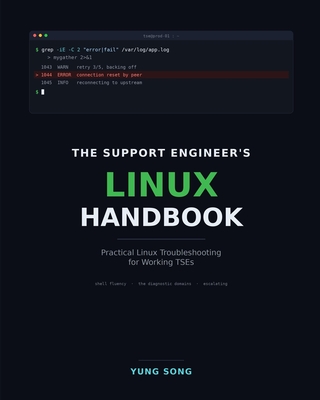
You've copied a senior's dense one-liner without understanding a single piece of it - then stared at it later wondering what 2>&1 actually did. This book is the missing explanation. Written for the working Technical Support Engineer - the person on the ticket, on the call, sharing a screen while a production box misbehaves - it builds the real troubleshooting toolkit from the ground up. It assumes you can get around a shell and nothing more, then teaches the commands, the mental models, and the traps that come up again and ...
Read More
You've copied a senior's dense one-liner without understanding a single piece of it - then stared at it later wondering what 2>&1 actually did. This book is the missing explanation. Written for the working Technical Support Engineer - the person on the ticket, on the call, sharing a screen while a production box misbehaves - it builds the real troubleshooting toolkit from the ground up. It assumes you can get around a shell and nothing more, then teaches the commands, the mental models, and the traps that come up again and again in real support work, the way a patient senior would explain them if they had the time. Inside, you'll learn to: Read the shell like a senior - streams, redirection, pipes, and the operators every command stands on Find and ship the right diagnostics, and grep/sed/awk your way through noisy output Master journalctl, parse logs, and stitch scattered logs into one timeline - even across time zones Work the diagnostic domains one at a time: services and processes, open files and connections, hung vs. waiting, threads, memory, disk and storage, CPU, and the network Capture core dumps and backtraces, and turn a diagnosis into an escalation a developer can act on No encyclopedic detours - just the working subset that solves real tickets, plus a field-tested triage script that points you straight to the right chapter. If you've ever wanted the senior who finally explains the one-liner, this is it.
Read Less