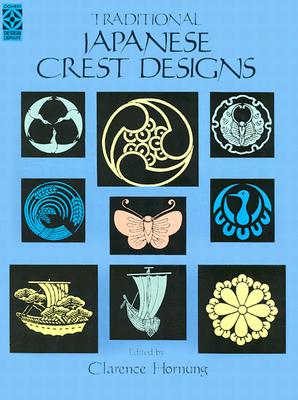
Over 500 royalty-free stylized motifs feature plants, animals, abstracts, geometrics, and more. Small, compact, and graceful designs, perfect for spot illustrations, logos, and other graphics, but also a fascinating picture book of Japanese culture. Read More
Over 500 royalty-free stylized motifs feature plants, animals, abstracts, geometrics, and more. Small, compact, and graceful designs, perfect for spot illustrations, logos, and other graphics, but also a fascinating picture book of Japanese culture. Read Less
Add this copy of Traditional Japanese Crest Designs (Dover Pictorial to cart. $8.95, good condition, Sold by Your Online Bookstore rated 5.0 out of 5 stars, ships from Houston, TX, UNITED STATES, published 1987 by Dover Publications.
Add this copy of Traditional Japanese Crest Designs (Dover Pictorial to cart. $8.98, very good condition, Sold by The Maryland Book Bank rated 5.0 out of 5 stars, ships from baltimore, MD, UNITED STATES, published 1987 by Dover Publications.
Add this copy of Traditional Japanese Crest Designs (Dover Pictorial to cart. $11.99, very good condition, Sold by Housing Works Online Bookstore rated 5.0 out of 5 stars, ships from New York, NY, UNITED STATES, published 1987 by Dover Publications.
Add this copy of Traditional Japanese Crest Designs (Dover Pictorial to cart. $12.18, very good condition, Sold by Vashon Island Books rated 5.0 out of 5 stars, ships from Vashon, WA, UNITED STATES, published 1987 by Dover Publications.
Add this copy of Traditional Japanese Crest Designs (Dover Pictorial to cart. $15.28, very good condition, Sold by hellertownbooks rated 5.0 out of 5 stars, ships from Hellertown, PA, UNITED STATES, published 1987 by Dover Publications.
Add this copy of Traditional Japanese Crest Designs to cart. $17.95, new condition, Sold by West Coast Bookseller rated 5.0 out of 5 stars, ships from Moorpark, CA, UNITED STATES, published by Dover Pubns.
Add this copy of Traditional Japanese Crest Designs to cart. $22.00, very good condition, Sold by Hennessey + Ingalls rated 5.0 out of 5 stars, ships from Los Angeles, CA, UNITED STATES, published 1987 by Dover Publications.
Choose your shipping method in Checkout. Costs may vary based on destination.
Seller's Description:
Used-Very Good. Over 500 royalty-free stylized motifs feature plants, animals, abstracts, geometrics, and more. Small, compact, and gracefuldesigns, perfect for spot illustrations, logos, and other graphics, but also a fascinating picture book of Japanese culture. ' Very nice clean, tight copy free of any marks.
Add this copy of Traditional Japanese Crest Designs to cart. $42.00, good condition, Sold by Ground Zero Books, Ltd. rated 5.0 out of 5 stars, ships from Silver Spring, MD, UNITED STATES, published 1986 by Dover Publications, Inc.
Choose your shipping method in Checkout. Costs may vary based on destination.
Seller's Description:
Good. No dust jacket issued. [4], 44 pages. Illustrations. Cover has some wear and soiling. Clarence Pearson Hornung (June 12, 1899-January 2, 1997) was an American trademark and industrial graphic designer and illustrator. This book belongs to the Dover Pictorial Archives Series. The reader may use the designs and illustrations for graphics and crafts applications, free and without special permission, provided that the user includes no more than ten in the same publication or project. Family crests (mon) have been a Japanese tradition since the eleventh century, when they decorated the costumes and carriages of courtiers. Later, they were used to identify warriors on the battlefield, as heraldic decorations on formal costumes, and as ornament on the kimonos of the common people. Small, compact, and graceful, with a strong sense of style, crest designs are ideal for spot illustrations, as logos, or for any graphic purpose requiring the classic simplicity, purity, and strength of Japanese design. This volume presents a total of 540 permission-free motifs, carefully selected for graphic impact and usefulness from several thousand crests known to exist. Featured are a wide variety of stylized designs depicting plants, animals, natural phenomena, geometric shapes, and manufactured objects. Among the subjects included in this selection are such traditional Japanese motifs as bamboo, crane, lightning, cherry blossom, peony, plum blossom, wave, rice, circle, and hollyhock. This is a fascinating picture book of Japanese culture. The term "Kamon" refers to a crest used in Japan to indicate one's origins; that is, one's family lineage, blood line, ancestry and status from ancient times. It is also referred to simply as "Mondokoro" or "Mon". It is said that there are more than 20, 000 distinct individual Kamon in Japan. Kamon are often referred to as Family Crests which are European heraldic device similar to the Kamon in function, but it is different in many ways. Except for European heraldic device, none of the countries have similar traditional heraldic device system which identifies family or clan. Kamon is a unique culture and tradition you can find only in Japan. It can be said that Kamon is an example of Japan's own culture which has been in use up to the present day. A Kamon was created to serve as an unique emblem that represented a family's identity, clearly revealing the family name of its owner. Later, Buke (samurai warriors) and Kuge (the nobility) made use of Kamon, which are classified into some groups according to blood line or historical origin. Each group consists of representative Kamon and their variations. Kamon spread widely and were used on even graves, furniture, and ships. It was natural for Kamon to be placed on weapons like Samurai Sword (Katana) and Samurai armor (Kacchu). However, although there were no limitations placed upon usage, freely using other family's Kamon caused friction or conflict. Especially using Kamon of a higher class, such as Daimyo (Japanese feudal lord) or Shogun (general) created more friction. Hence, there was an unspoken rule to avoid using the Kamon that is already used by high class clan or family as much as possible. The origin of Kamon goes far back to the latter part of Heian Period. Around the end of Heian Period, Kuge (the nobility) such as; Sanesue SAIONJI and Saneyoshi TOKUDAIJI, began placing their own Mon on their oxcarts and walked around Streets, showing off their Mon. Afterwards, Kamon became popular among Kuge and various Kamon were created. The Kamon of Buke (Samurai warriors) were created later than those of Kuge at the end of the Heian Period, when conflict between Heiji-clan and Genji-clan became more violent. It is considered to have originated from the fact that Samurai used their original designs on Hatamaku (samurai flag) or Manmaku (samurai curtains) to advertise their achievements or to show off. It seems that in the middle of Kamakura Period almost all samurai...