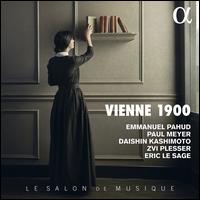
The title Vienne 1900, or Vienna 1900, is superficially misleading; the works here all date from either before or (mostly) after 1900, with the Webern arrangement of Schoenberg's Kammersymphonie No. 1, Op. 9, dating from as late as 1923. Yet the title is instructive: the chamber group led by flutist Emmanuel Pahud seems to suggest that the music of the period drew on a common structure of feeling, which might manifest itself in retrospective or future-oriented ways. The group can draw on plenty of evidence. Alexander von ...
Read More
The title Vienne 1900, or Vienna 1900, is superficially misleading; the works here all date from either before or (mostly) after 1900, with the Webern arrangement of Schoenberg's Kammersymphonie No. 1, Op. 9, dating from as late as 1923. Yet the title is instructive: the chamber group led by flutist Emmanuel Pahud seems to suggest that the music of the period drew on a common structure of feeling, which might manifest itself in retrospective or future-oriented ways. The group can draw on plenty of evidence. Alexander von Zemlinsky, represented here by the youthful Clarinet Trio in D minor, Op. 3, was the teacher of both Schoenberg and Erich Korngold, later a star in Hollywood and here offering the extremely precocious Piano Trio, Op. 1 (Korngold was just 12 when he wrote it). Pahud and company strike a languid tone that extends across the entire program and thus emphasizes their attempt to find commonalities. It's a fresh approach: Schoenberg and Berg are more often given an edgy restlessness to go...
Read Less