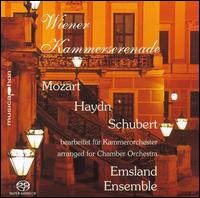
This "Vienna Chamber Serenade" would, in its essentials, not have sounded unusual or out of place to a Viennese audience of the early nineteenth century -- arrangements of orchestral works for smaller ensembles were made as the need arose to serve the requirements of aristocratic households, and especially handy ones were published and earned monetary rewards for their now forgotten makers. The arrangements here are contemporary, and they're full of delightful precision in the ways they reduce orchestral textures to an ...
Read More
This "Vienna Chamber Serenade" would, in its essentials, not have sounded unusual or out of place to a Viennese audience of the early nineteenth century -- arrangements of orchestral works for smaller ensembles were made as the need arose to serve the requirements of aristocratic households, and especially handy ones were published and earned monetary rewards for their now forgotten makers. The arrangements here are contemporary, and they're full of delightful precision in the ways they reduce orchestral textures to an octet consisting of one each of the members of the orchestral string family, plus clarinet, horn, and bassoon. Germany's Emsland-Ensemble is sprightly indeed in the opening Schubert Overture in D major in the Italian Style, D. 590, and it does admirably at solving the balance problems that come up when a horn appears in the midst of a group of solo instruments -- the controlled horn playing of Holger Nießing is a marvel in itself. The Mozart "Posthorn" Serenade, K. 320, was a light work...
Read Less