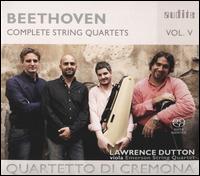
Since 2013, the Quartetto di Cremona has been issuing all of Ludwig van Beethoven's chamber music for strings on hybrid SACD, and for the fifth volume in the project, the group presents the String Quintet in C major, Op. 29, featuring Lawrence Dutton as the second violist, and the String Quartet in A minor, Op. 132, one of Beethoven's greatest achievements. This is a suitable match-up, in terms of key relationships and the expansive nature of their respective forms: the String Quintet begins to approach the length of the ... Read More
Since 2013, the Quartetto di Cremona has been issuing all of Ludwig van Beethoven's chamber music for strings on hybrid SACD, and for the fifth volume in the project, the group presents the String Quintet in C major, Op. 29, featuring Lawrence Dutton as the second violist, and the String Quartet in A minor, Op. 132, one of Beethoven's greatest achievements. This is a suitable match-up, in terms of key relationships and the expansive nature of their respective forms: the String Quintet begins to approach the length of the late quartets, of which the String Quartet in A minor is one of the longest because of its eighteen-minute Adagio, the famous "Heiliger Dankgesang" movement. The Quartetto di Cremona plays with considerable energy and bravado, and their fast movements are quite exciting for their rhythmic vitality and occasional brusqueness. But the sustained beauty of tone and sublime feeling of their slow movements will repay repeated listening. Audite's recorded sound is clear and full of presence,... Read Less
Add this copy of Beethoven: Complete String Quartets, Vol. 5 to cart. $12.25, Sold by New England Booksellers rated 3.0 out of 5 stars, ships from Greenfield, MA, UNITED STATES, published 2016 by Audite.
A Songful Performance In A Beethoven Quartet Cycle
The lyrical, songlike aspects of Beethoven receive emphasis in this fifth volume of the 16 Beethoven string quartets by the Quartetto Di Cremona. Founded by students of the Cremonese Conservatory, the quartet has been together for about fifteen years.. Each member of the quartet performs on a historical instrument of the Cremonese school of violin making. The Quartetto Di Cremona is a worthy successor to the Quartetto Italiano as the premier Italian string quartet. This CD is my first exposure to the ensemble, and thus I come to its Beethoven cycle towards the end. I have read the impressive reviews here on Amazon of the prior four volumes. In its performance of the cycle, the Quartetto Di Cremona has adopted a "mixed" approach by including works from Beethoven's three compositional periods on each CD rather than performing the works by opus number.
This CD includes a work from Beethoven's first period, the opus 29 string quintet, and a work from his final period, the A minor string quartet, opus. 132. Although these two works are highly different, they both work beautifully with the lyrical, singing reading the Quartetto gives them.
Opus 29 is Beethoven's only original string quintet although he arranged two other compositions in this form. Violist Lawrence Dutton of the Emerson String Quartet joins the ensemble in this work. Beethoven's string quintet is a rarely-performed masterpiece and a find for a composer much of whose work is familiar. It is both radiant and serene with hints of underlying melancholy in each of its four movements. The first violin is emphasized throughout with long singing themes in the instrument's upper register. The work also includes extensive counterpoint, particularly in the finale, and lovely, close textures, including a pizzicato accompaniment to the first violin in the flowing slow movement. The opening movement develops a long singing theme and a somewhat more reclusive second theme. The intimate slow movement is interrupted twice by sections in the minor key while the short scherzo showcases the solo violin and cello. The finale begins with a dramatic tremolo and, as in the prior movements, is twice interrupted in its flow by minor key sections. I have grown to love the op. 29 quintet over the years and have reviewed it twice before on Amazon: in 2006 with the Zurich String Quintet and in 2010 with the Fine Arts Quartet and violist Gil Sharon. It was a joy to return to the quintet in this beautiful singing performance.
There is a tendency to over-emphasize the structural, thematic aspects of Beethoven's music together with what my friend Scott Morrison describes in his review of the first volume of the Quartetto Di Cremona's cycle as the composer's "pride, stubbornness, crustiness, and complete originality". So it is, but this description overlooks the strongly lyrical character of much of Beethoven which is found in the final work on this CD, the great string quartet no. 14 in A minor, op. 132, as well as in the string quintet. The centerpiece of the work is expressly cast as a song, the "Holy Song of Thanksgiving to the Deity in Recovery from an Illness in the Lydian Mode." This movement is a sublime moment of song in its serene theme combined with its more passionate sections. The remaining four movements of the quartet also have strongly lyrical components with the exception of the brief, fourth movement angular march. The opening movement with its many shifts of mood and direction relies as much on song as on thematic texture, while the second movement has an almost rustic simplicity at times in its lyricism. The yearning finale is dramatic and passionate, but it sings above all. The reading by the Quartetto Di Creomona heloped me focus on the lyrical character of this music to a greater extent than I had done before. Their reading stresses the songlike components of the work without sacrificing the structure. In 2005, I reviewed the Guarneri Quartet's cycle of the Beethoven quartets. My review emphasized the performance of the op. 132 quartet, as I was recovering from an illness of my own at the time. It was a joy again to return to op. 132 in the recording by the Quartetto Di Cremona.
The CD was recorded in Italy in 2014. The liner notes are unusually good and they emphasize the approach taken in the performance. For example, the notes to op. 132 quote an earlier critic who wrote: "It is the vocal character which holds together the A minor Quartet more than the motivic element." The writer of the notes continues on his own: "Indeed there is hardly any theme -- with the exception of the march which is clearly defined as an instrumental genre -- that does not originate from a vocal spirit." The CD is on the Audite label and distributed by Naxos. Naxos kindly sent me a review copy.